






Choosing the right boarding school is an important decision for parents who want to provide their daughters with quality education, personal development, and a supportive learning environment. However, understanding the Girls Boarding School Admission Process is equally important before beginning the application.
From researching schools and checking eligibility to submitting documents, attending entrance assessments, and completing enrolment, every stage requires careful planning. A clear understanding of the Girls Boarding School Admission Process helps parents prepare in advance and avoid last-minute confusion.
Although admission requirements vary between schools, most institutions follow a series of common steps. This guide explains the Girls Boarding School Admission Process, including application procedures, required documents, eligibility criteria, entrance assessments, and admission timelines.
Table of Contents
- Understanding the Girls Boarding School Admission Process
- Step-by-Step Girls Boarding School Admission Process
- Documents Required for Boarding School Admission
- Eligibility Criteria for Girls Boarding Schools
- Boarding School Admission Timeline
- Entrance Tests and Admission Interviews
- Factors to Consider Before Applying
- Common Admission Mistakes Parents Should Avoid
- Frequently Asked Questions
- Conclusion
Understanding the Girls Boarding School Admission Process

The Girls Boarding School Admission Process refers to the series of steps parents and students complete to secure admission to a residential school. It generally includes school selection, enquiry, application submission, document verification, academic assessment, and final enrolment.
Each school may have its own admission policy, application deadlines, eligibility requirements, and assessment methods. Some schools accept applications throughout the year, while others follow a fixed admission calendar.
Before starting the Girls Boarding School Admission Process, parents should understand the following:
- Classes and age groups for which admission is available
- Academic curriculum and subject options
- Eligibility and previous academic requirements
- Application forms and registration procedures
- Documents required for admission
- Entrance tests or student interactions
- Fee structure and payment deadlines
- Boarding facilities and student support arrangements
Understanding these requirements early can help families make informed decisions and complete the admission process smoothly.
Step-by-Step Girls Boarding School Admission Process
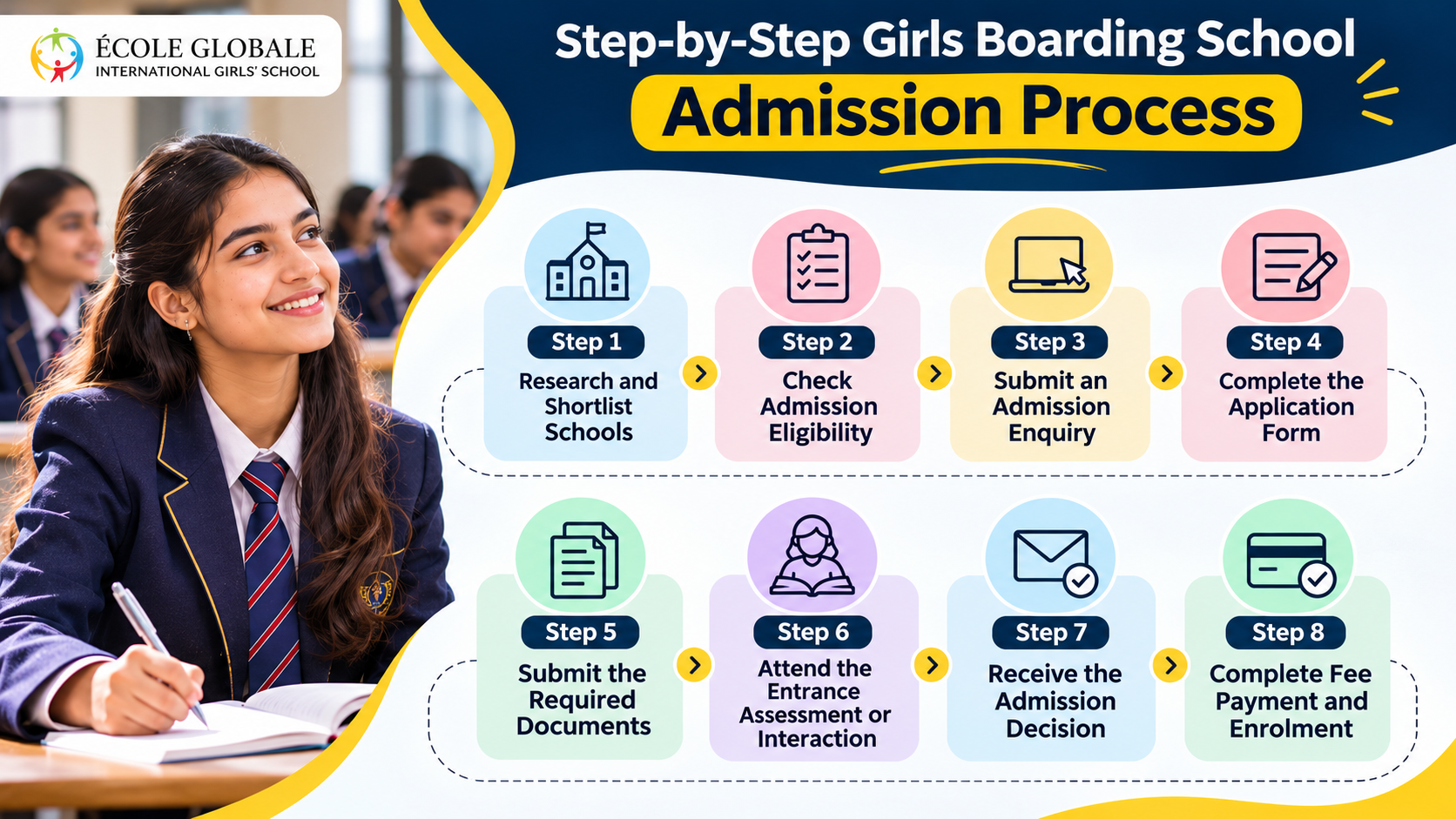
The Girls Boarding School Admission Process becomes easier to manage when parents follow a structured approach. Although individual school procedures may differ, the following steps provide a useful general guide.
Step 1: Research and Shortlist Schools
The first step is to identify boarding schools that match your daughter’s academic needs, interests, and preferences.
Parents should compare schools based on:
- Academic curriculum and teaching approach
- Academic performance and learning support
- Boarding accommodation and facilities
- Sports and extracurricular activities
- Student safety and supervision
- Healthcare and counselling facilities
- Location and accessibility
- Fee structure and additional charges
Shortlisting suitable institutions helps parents focus their efforts on schools that meet their expectations.
Step 2: Check Admission Eligibility
Once you have shortlisted schools, review their admission requirements. Eligibility criteria may include the student’s age, previous class, academic records, and availability of seats.
Some schools also have specific requirements for admission to higher classes or particular academic programmes.
Checking eligibility before applying is an essential part of the Girls Boarding School Admission Process because it helps parents avoid applications that do not meet the school’s criteria.
Step 3: Submit an Admission Enquiry
Most schools allow parents to submit an online or offline admission enquiry. This gives families an opportunity to receive information about available classes, admission dates, fees, facilities, and application procedures.
During this stage, parents can also ask questions about campus visits, hostel accommodation, student supervision, and the school’s communication policies.
Step 4: Complete the Application Form
After receiving the necessary information, parents can proceed with the official application form.
The form generally requests details such as:
- Student’s full name and date of birth
- Previous school information
- Current or last attended class
- Academic details
- Parent or guardian information
- Residential address and contact details
- Medical information, where required
Parents should carefully check all information before submitting the form. Incorrect or incomplete details may delay further processing.
Step 5: Submit the Required Documents
Document submission is another important stage of the Girls Boarding School Admission Process. Schools generally request academic records, identity and age proof, photographs, and parent or guardian details.
The exact document list varies by institution and admission class. Parents should follow the school’s official checklist rather than relying on a general list.
Step 6: Attend the Entrance Assessment or Interaction
Depending on the school and class, applicants may be required to attend an entrance examination, academic assessment, or student interaction.
These assessments may help the school understand the student’s current academic level, communication abilities, and learning needs.
Parents should check the assessment format and prepare their daughters appropriately without creating unnecessary academic pressure.
Step 7: Receive the Admission Decision
After reviewing the application, documents, and any required assessments, the school communicates its admission decision.
If the application is successful, parents may receive an admission offer along with information about fee payment, enrolment deadlines, and joining instructions.
Step 8: Complete Fee Payment and Enrolment
The final stage of the Girls Boarding School Admission Process involves completing the required formalities.
Parents should carefully review the admission offer, fee schedule, payment deadlines, refund policy, and other school terms before confirming the seat.
Once the required formalities are completed, the school provides further instructions regarding the joining date, uniform, books, hostel essentials, and orientation.
Documents Required for Boarding School Admission
Preparing documents in advance can make the Girls Boarding School Admission Process more convenient. While the exact requirements differ between schools, the following documents are commonly requested.
| Document | Purpose |
|---|---|
| Birth certificate | Verification of the student’s date of birth |
| Previous academic report cards | Review of academic performance |
| Transfer Certificate (TC) | Confirmation of previous school details |
| Passport-size photographs | Student identification and school records |
| Address proof | Verification of residential details |
| Parent or guardian identity proof | Verification of parent or guardian information |
| Medical records | Understanding relevant health requirements |
| Migration certificate | May be required when changing boards or school systems |
Some schools may request additional documents, such as a character certificate, category certificate where applicable, or other declarations.
Tips for Preparing Admission Documents
- Keep original documents available for verification.
- Prepare clear photocopies or digital scans.
- Check that the student’s name and date of birth match across documents.
- Confirm whether documents need to be self-attested.
- Ask the school about any additional requirements.
- Keep a separate folder for admission-related paperwork.
A prepared document checklist can reduce delays during the Girls Boarding School Admission Process.
Eligibility Criteria for Girls Boarding Schools
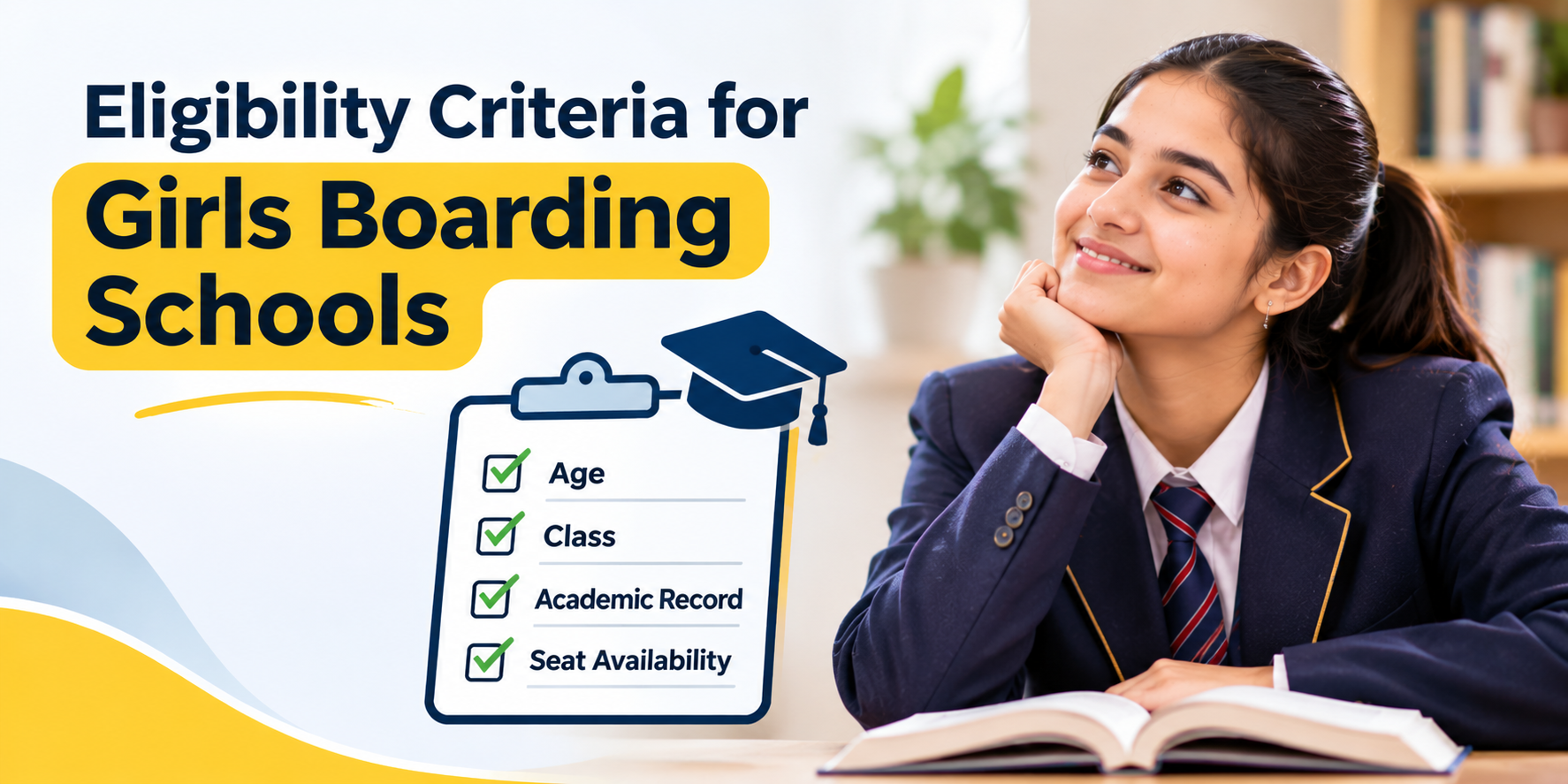
Eligibility requirements depend on the institution, class, curriculum, and availability of seats. Parents should always check the official admission guidelines before submitting an application.
Age Requirements
Schools may specify age criteria for particular classes. These requirements can differ depending on the school’s admission policy and applicable educational guidelines.
Parents should confirm the accepted age range directly with the admission office.
Previous Academic Performance
Previous report cards may be reviewed to understand the student’s academic progress and identify any learning support she may need.
Some schools may specify minimum academic requirements for admission to particular classes.
Class Availability
Admission is generally subject to seat availability. Entry into certain classes may be limited, especially where students are expected to continue an existing academic programme.
Curriculum Compatibility
Students transferring from another school board or curriculum may need to meet additional academic or documentation requirements.
For example, a student moving between CBSE, ICSE, and international curricula may need guidance regarding subject selection and academic progression.
Understanding these requirements is an important part of the Girls Boarding School Admission Process.
Boarding School Admission Timeline
Parents should begin planning the Girls Boarding School Admission Process well before the intended joining date. Early preparation provides enough time to compare schools, arrange documents, attend assessments, and complete enrolment formalities.
The following is an illustrative timeline. Actual dates and deadlines depend on the school.
| Stage | Suggested Time |
|---|---|
| Research and shortlist schools | 6–9 months before joining |
| Admission enquiry and campus visit | 4–6 months before joining |
| Application form submission | 3–5 months before joining |
| Document submission | As specified by the school |
| Entrance assessment or interaction | As scheduled by the school |
| Admission decision | As communicated by the school |
| Fee payment and enrolment | Before the stated deadline |
| Joining and orientation | According to the academic calendar |
When Should Parents Apply?
There is no universal admission opening date for all girls’ boarding schools. Some institutions announce admission schedules several months before the academic session, while others may accept applications depending on seat availability.
Parents should contact their preferred schools early and confirm the current admission calendar.
Starting the Girls Boarding School Admission Process early is particularly useful when applying for popular classes or schools with limited residential capacity.
Entrance Tests and Admission Interviews
Entrance assessments and student interactions may form part of the Girls Boarding School Admission Process, depending on the school’s admission policy.
Academic Entrance Assessments
Schools may assess a student’s understanding of subjects such as:
- English
- Mathematics
- Science
- General knowledge
- Other subjects relevant to the entry class
The purpose is generally to understand the student’s academic level and determine whether she can comfortably continue with the school’s curriculum.
Student Interaction
Some schools arrange an interaction with the applicant to understand her interests, communication skills, learning preferences, and expectations.
This may also give students an opportunity to ask questions about school life.
Parent Interaction
Parents may be invited to discuss their daughter’s educational background, interests, expectations, and any support requirements.
How to Prepare
Parents can help their daughters prepare by:
- Reviewing concepts from the previous class.
- Encouraging regular reading and communication.
- Explaining what to expect during the interaction.
- Helping them understand the school’s academic and residential environment.
- Allowing them to ask questions freely.
The aim should be to help students feel comfortable and informed rather than treating admission assessments as high-pressure examinations.
Factors to Consider Before Applying
Completing the Girls Boarding School Admission Process should not be the only objective. Parents must also ensure that the selected school is appropriate for their daughter’s educational and personal development.
Academic Environment
Review the curriculum, teaching methods, subject options, academic support, and examination preparation offered by the school.
Boarding Accommodation
Understand the hostel arrangements, room facilities, hygiene standards, supervision, and daily residential routines.
Safety and Student Wellbeing
Ask about student supervision, healthcare arrangements, emergency procedures, counselling support, and how the school handles student concerns.
Sports and Extracurricular Activities
A balanced school experience should provide opportunities to explore sports, arts, music, cultural activities, clubs, and other interests.
Communication with Parents
Understand how the school communicates academic progress, health updates, important announcements, and student wellbeing concerns.
Fee Structure
Request a complete fee breakdown, including admission charges, tuition fees, boarding expenses, deposits, and other applicable costs.
Parents should also clarify the payment schedule and refund policy before confirming admission.
Common Admission Mistakes Parents Should Avoid

Even with a clear understanding of the Girls Boarding School Admission Process, parents may overlook important details during application and enrolment.
Applying Without Checking Eligibility
Submitting an application without reviewing age, class, and academic requirements can lead to unnecessary delays.
Missing Admission Deadlines
Late applications may not be considered if seats are limited or the admission window has closed.
Submitting Incomplete Documents
Missing certificates, incorrect details, or unclear copies may delay document verification.
Choosing a School Only Based on Reputation
A school’s popularity does not automatically make it the right choice for every student. Parents should consider academic needs, residential facilities, safety, support systems, and their daughter’s preferences.
Ignoring the Total Cost
Parents should understand the complete fee structure rather than focusing only on the initial admission fee.
Not Visiting the Campus
When possible, visiting the school can help parents evaluate its facilities and understand the residential environment more clearly.
Avoiding these mistakes can make the Girls Boarding School Admission Process more organised and help families make a better-informed decision.
Conclusion
Understanding the Girls Boarding School Admission Process helps parents approach school selection and enrolment with greater clarity. From researching suitable institutions and checking eligibility to preparing documents, attending assessments, and completing admission formalities, each step deserves careful attention.
A well-planned Girls Boarding School Admission Process also gives families time to evaluate the school’s academic environment, residential facilities, student wellbeing arrangements, and overall suitability.
Parents should begin early, verify all requirements directly with the school, and involve their daughters in the decision-making process. The right boarding school should offer more than academic education: it should provide a supportive environment where girls can learn, develop independence, explore their interests, and grow with confidence.
Frequently Asked Questions
Q1. What is the girls boarding school admission process?
Ans: The Girls Boarding School Admission Process generally involves researching schools, checking eligibility, submitting an enquiry and application form, providing required documents, attending assessments if applicable, receiving an admission decision, and completing enrolment formalities.
Q2. What documents are required for girls boarding school admission?
Ans: Commonly requested documents include a birth certificate, previous academic report cards, Transfer Certificate, photographs, address proof, parent or guardian identity proof, and relevant medical records. Requirements vary by school.
Q3. When should parents apply for boarding school admission?
Ans: Parents should ideally begin researching schools six to nine months before the intended joining date. However, application opening dates and deadlines vary, so families should confirm the current schedule with each school.
Q4. Is an entrance exam compulsory for boarding school admission?
Ans: Not always. Some schools conduct entrance examinations or academic assessments, while others may use student interactions, previous academic records, or a combination of these methods.
Q5. Can students transfer to a girls’ boarding school in the middle of an academic year?
Ans: Some schools may consider mid-year admissions if seats are available and the student’s academic requirements can be accommodated. Parents should contact the admission office to understand the school’s policy.
Q6. How can parents check whether a girls’ boarding school is suitable?
Ans: Parents should review the school’s curriculum, academic support, boarding facilities, student supervision, healthcare, safety arrangements, extracurricular activities, and communication policies. A campus visit can provide additional insight.