





The concept of an AI teacher in India is no longer science fiction. From personalized lesson plans to automated assessments and virtual tutors, artificial intelligence is making its way into classrooms across the country.
As schools seek scalable ways to improve learning outcomes and bridge resource gaps, AI-powered tools offer tempting possibilities.
This article examines what an AI teacher looks like in the Indian context, its benefits, limitations, and practical steps for responsible adoption.
What do we mean by “AI teacher in India”?
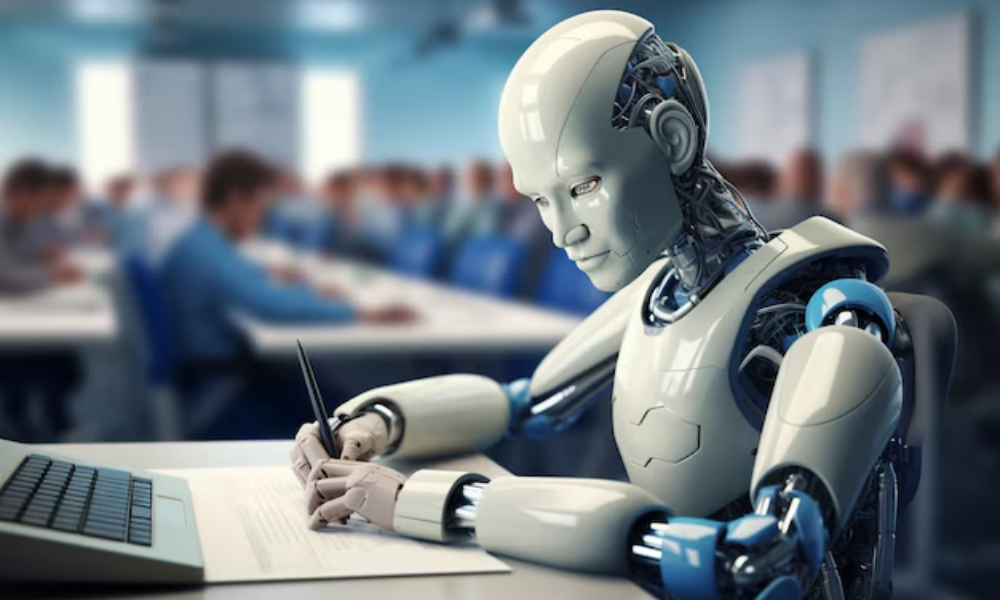
An AI teacher in India refers to software systems and platforms that assist, augment, or sometimes replace parts of traditional teaching. These range from:
Virtual tutors that explain concepts and answer student queries,
Intelligent tutoring systems that personalise learning paths,
Automated grading tools for objective assessments,
Chatbots for doubt resolution and administrative help,
Analytics dashboards that help teachers track student progress.
In most practical settings, AI complements human teachers rather than fully replacing them.
Key benefits of introducing an AI teacher in India
1. Personalized learning at scale
AI can tailor lessons to each student’s strengths, weaknesses, and pace. In diverse classrooms common in India, personalised AI lessons help close learning gaps without overburdening teachers.
2. Immediate feedback and assessment
Automated quizzes, instant feedback, and performance analytics help students correct mistakes quickly and allow teachers to focus on conceptual teaching.
3. Resource efficiency
AI tools can reduce the grading load, automate administrative tasks, and free teachers’ time for one-on-one mentoring and creative lesson design.
4. Access to quality content
Schools in remote areas can access high-quality instructional videos, simulations, and adaptive exercises curated or generated by AI systems.
5. Continuous improvement for teachers
AI analytics reveal class-level trends and common misconceptions, enabling teachers to refine pedagogy and target interventions more effectively.
Practical classroom applications in India

Remedial learning modules: AI identifies weak topics (e.g., fractions, grammar) and pushes short micro-lessons.
Language support: Speech-to-text and pronunciation feedback help with English or second-language learning.
Exam preparation: Adaptive mock tests adjust difficulty based on student responses—valuable for board exam coaching.
Parent and school communication: Chatbots and automated reports keep parents informed about attendance and progress.
Inclusive education: AI tools can offer text-to-speech, translations and accessible formats for children with special needs.
Challenges and risks for an AI teacher in India
1. Digital divide and infrastructure
Reliable internet, devices, and electricity are not universal. AI works best with consistent connectivity and hardware—constraints in many parts of India.
2. Quality and bias in content
AI models trained on poor or biased data can produce inaccurate or culturally insensitive content. Localisation is critical.
3. Teacher readiness and training
Teachers need professional development to integrate AI effectively—designing blended lessons, interpreting analytics, and maintaining pedagogy.
4. Privacy and data security
Student data must be protected. Schools need clear policies on data storage, consent, and third-party access to ensure compliance and trust.
5. Overreliance and reduced human interaction
Education is relational. Excessive dependence on AI risks undermining the mentorship and emotional support that human teachers uniquely provide.
Policy, ethics, and regulatory considerations
For the AI teacher in India model to succeed ethically, policy-makers, edtech companies, and schools must collaborate on:
Clear data protection rules (consent, anonymisation, retention limits),
Standards for AI content quality and accuracy,
Guidelines for teacher training and role definition, and
Pilot programs with evaluation metrics before widescale deployment.
India’s education authorities and boards can encourage pilot studies, create evaluation frameworks, and fund infrastructure for equitable adoption.
Steps for schools to adopt AI responsibly

Start small with pilots — test AI tutoring on a subject or grade.
Invest in teacher training — focus on blended lesson design and data interpretation.
Choose reputable vendors — look for transparency on data usage, model sources, and localisation.
Involve parents — communicate benefits, data safeguards, and how AI fits into teaching.
Measure impact — track learning gains, engagement, and teacher workload changes.
Retain human oversight — every AI recommendation should be reviewable by a teacher.
The future: hybrid classrooms and collaborative intelligence
The most likely future for the AI teacher in India is a hybrid classroom where human teachers and AI systems work together.
AI will handle personalization, repetitive assessments, and data analysis, while teachers focus on mentoring, creativity, ethics and socio-emotional learning.
This collaborative intelligence model aims to multiply teacher effectiveness rather than replace the human touch.
FAQs — AI Teacher in India
Q1. Will AI replace teachers in India?
Ans: No. AI is most effective as an assistant. Human teachers provide emotional support, moral guidance, and nuanced judgment—roles AI cannot fully replicate.
Q2. How can schools with limited budgets try AI teaching tools?
Ans: Start with low-cost or free tools (open educational resources, chatbot pilots), seek government grants, or partner with NGOs and edtech pilots.
Q3. Is student data safe with AI platforms?
Ans: Safety depends on the provider. Choose platforms with clear data policies, encryption, and compliance with local data protection guidelines.
Q4. Which grades benefit most from an AI teacher?
Ans: AI is useful across grades, but early remedial support (primary) and adaptive exam prep (secondary) are high-impact areas.
Q5. How do teachers get trained to work with AI?
Ans: Training should combine technical use, pedagogical integration, interpreting analytics, and ethical considerations—ideally as ongoing professional development.
Q6. Can AI help inclusive education in India?
Ans: Yes. AI offers text-to-speech, translations, and personalized pacing that help learners with disabilities or language barriers.
Q7. Are Indian edtech companies building AI teachers?
Ans: Many Indian edtech firms and global providers are creating AI-driven tutors and assessment tools—localisation and curriculum alignment remain key.
Q8. What costs are involved in implementing AI in schools?
Ans: Costs include devices, connectivity, platform licenses, teacher training, and maintenance. Pilots help estimate realistic budgets.