



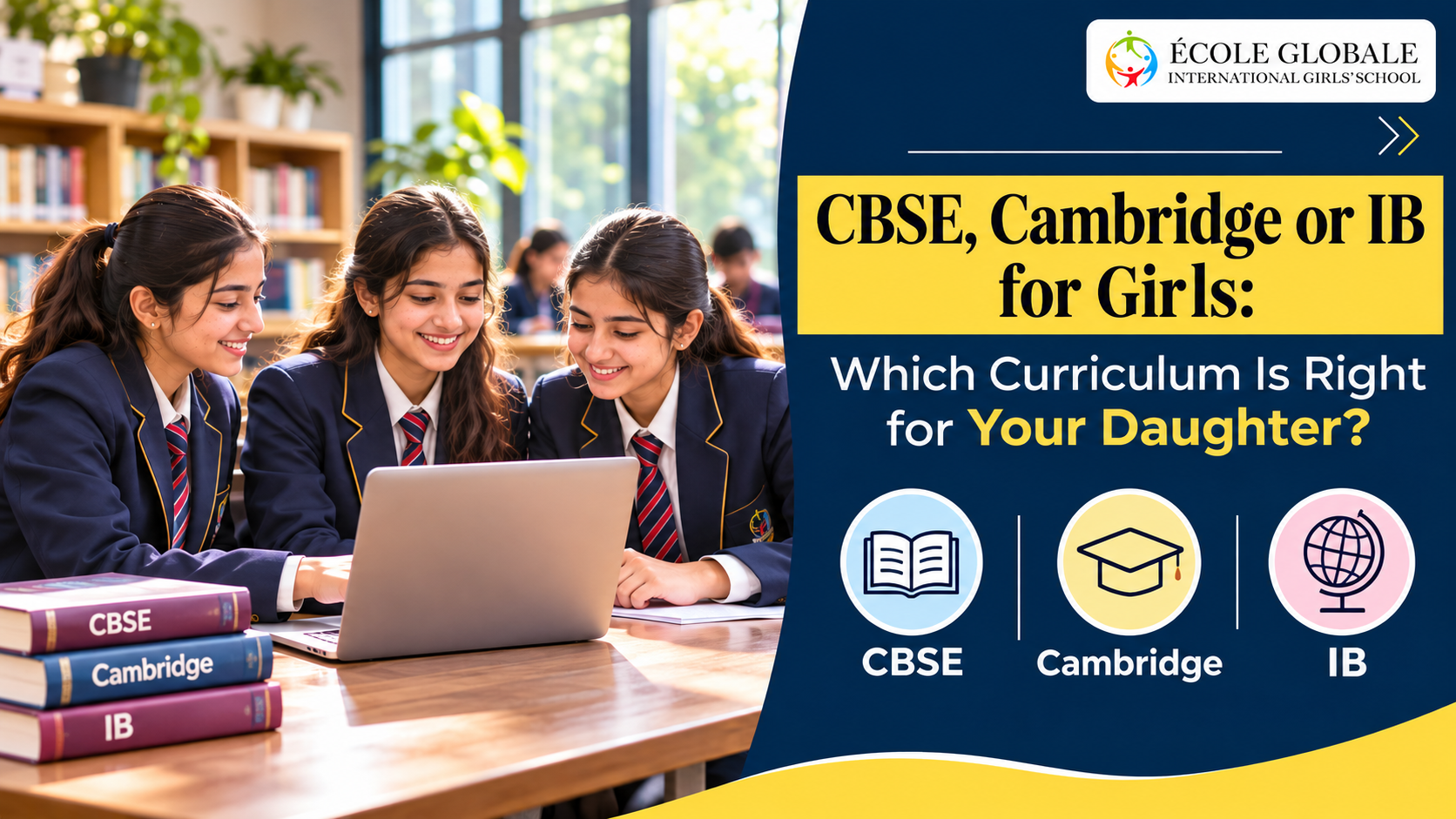
Choosing the right school curriculum is an important decision for parents. A curriculum influences how students learn, develop skills, approach examinations and prepare for higher education. When comparing CBSE, Cambridge or IB for Girls, parents should look beyond the curriculum’s popularity and consider their daughter’s learning preferences, academic interests and future goals.
Each curriculum offers a different educational approach. CBSE provides a structured academic framework, Cambridge encourages subject understanding and independent thinking, while the International Baccalaureate (IB) focuses on inquiry-based and holistic learning.
So, which is the best curriculum for girls? Let’s explore the differences between these three pathways and understand how parents can make an informed choice.
Understanding the CBSE Curriculum

The Central Board of Secondary Education (CBSE) is one of India’s widely recognised school education boards. It follows a structured curriculum designed to develop academic understanding across different subjects.
For parents considering CBSE, Cambridge or IB for Girls, CBSE can be a suitable option for students who prefer a well-defined academic structure and a familiar examination system.
Key Features of the CBSE Curriculum
- Structured learning: Provides a defined syllabus and organised subject progression.
- National recognition: CBSE qualifications are widely recognised by Indian universities and educational institutions.
- Competitive examination preparation: Its academic framework can support preparation for various Indian entrance examinations.
- Standardised assessment: Students are evaluated through prescribed examination and assessment systems.
- Subject-based learning: Focuses on developing knowledge and understanding across core academic subjects.
Benefits of CBSE Curriculum
The benefits of the CBSE curriculum include a structured approach to learning, familiarity with the Indian education system and a clear academic progression. It may be particularly relevant for families planning their daughter’s higher education in India.
What Makes the Cambridge Curriculum Different?

The Cambridge curriculum, offered through Cambridge International Education, provides an internationally oriented approach to learning. It encourages students to understand concepts, apply knowledge and develop independent learning skills.
When comparing CBSE, Cambridge or IB for Girls, Cambridge may appeal to parents looking for flexibility in subject choices and an international academic framework.
Key Features of the Cambridge Curriculum
- Conceptual understanding: Encourages students to understand ideas rather than rely only on memorisation.
- Subject flexibility: Offers a range of subjects and pathways at different educational stages.
- Independent learning: Promotes research, critical thinking and self-directed study.
- Practical application: Encourages students to apply classroom knowledge to real-world situations.
- International perspective: Provides an educational framework used by schools in different countries.
Benefits of Cambridge Education
The benefits of Cambridge education include opportunities to develop analytical thinking, subject knowledge and independent learning habits. Its subject-based approach can help students explore their academic interests and prepare for different higher education pathways.
Exploring the IB Curriculum
The International Baccalaureate (IB) is an international education framework that emphasises inquiry, reflection and holistic development.
For parents evaluating CBSE, Cambridge or IB for Girls, the IB may be worth considering if they want an educational approach that connects academic learning with personal development and global awareness.
Key Features of the IB Curriculum
- Inquiry-based learning: Encourages students to ask questions, investigate topics and develop their own understanding.
- Critical thinking: Promotes analysis, evaluation and problem-solving.
- Interdisciplinary learning: Helps students understand connections between different subjects.
- Global awareness: Encourages an understanding of international issues and different perspectives.
- Personal development: Places importance on reflection, responsibility and engagement beyond academics.
Benefits of IB Education
The benefits of IB education include developing research skills, communication, independent thinking and an awareness of global perspectives. Its learning approach can suit students who enjoy exploring ideas, asking questions and connecting knowledge across different subjects.
CBSE vs Cambridge vs IB: Key Differences

Understanding the difference between CBSE and Cambridge, the difference between CBSE and IB, and Cambridge vs IB can help parents evaluate each pathway more effectively.
| Comparison | CBSE | Cambridge | IB |
|---|---|---|---|
| Educational approach | Structured and syllabus-based | Subject-focused and flexible | Inquiry-based and holistic |
| Learning emphasis | Academic knowledge and application | Conceptual understanding and independent learning | Critical thinking and interdisciplinary learning |
| Subject choices | Defined by the relevant academic stage | Offers a range of subject options | Depends on the IB programme |
| Assessment | Board examinations and school assessments | Examinations and other assessment methods, depending on the qualification | Internal and external assessment, depending on the programme |
| Educational orientation | Primarily aligned with the Indian education system | International | International |
| Suitable learning preference | Structured academic progression | Subject exploration and independent learning | Inquiry, reflection and interconnected learning |
No curriculum is automatically better than another. The right choice depends on the student’s interests, preferred learning environment and future academic plans.
How Each Curriculum Supports Girls’ Development
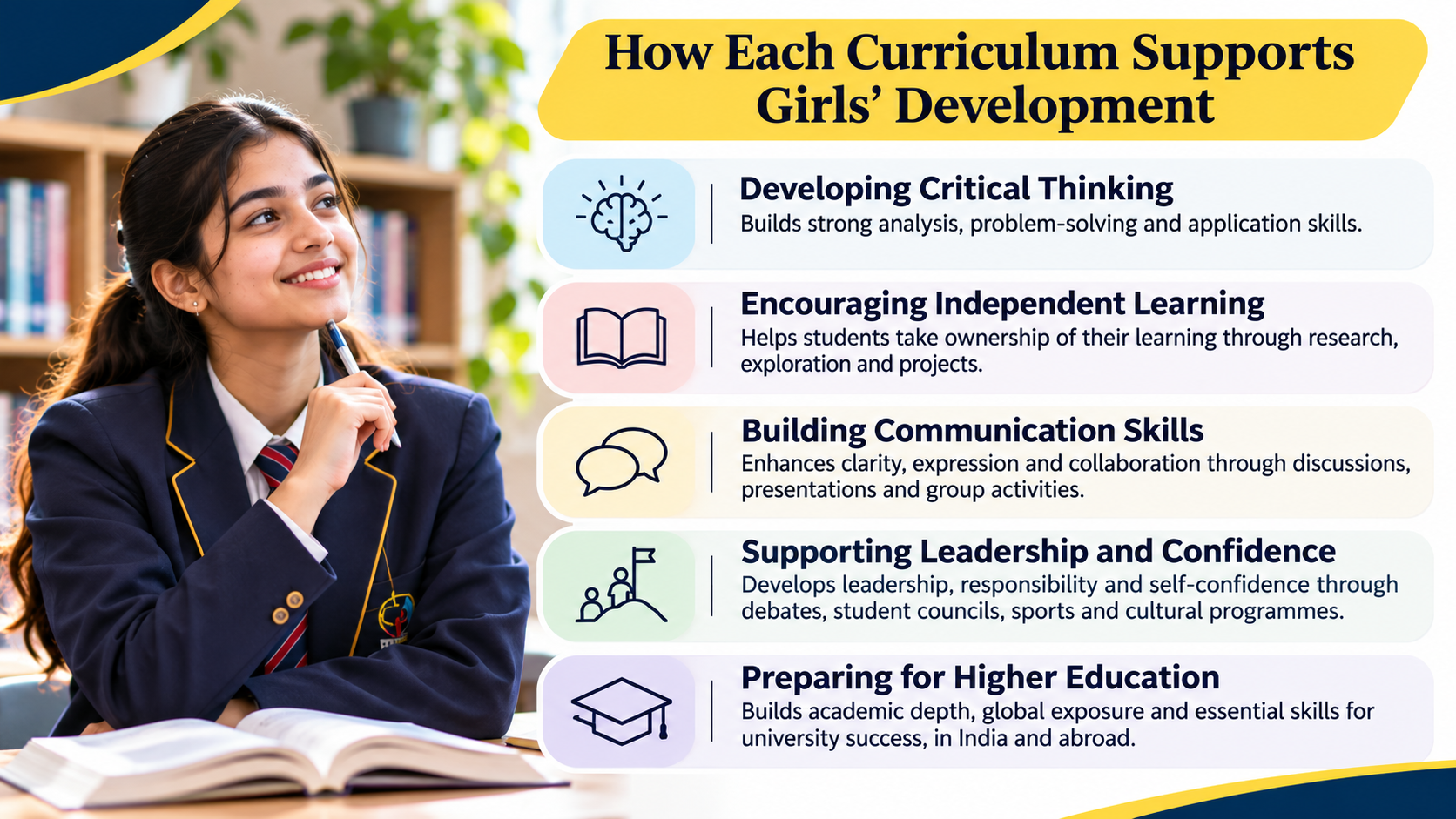
The discussion around CBSE, Cambridge or IB for Girls should not be limited to examination results. Parents should also consider how a curriculum supports confidence, communication, leadership and independent thinking.
1. Developing Critical Thinking
Cambridge and IB place considerable emphasis on conceptual understanding, inquiry and analysis. CBSE also encourages application-based learning through its academic framework. All three can support critical thinking when teaching methods and classroom activities are effective.
2. Encouraging Independent Learning
Independent learning helps students take responsibility for their academic progress. Cambridge and IB offer opportunities for research, exploration and self-directed learning, while CBSE students can also develop these skills through projects and classroom activities.
3. Building Communication Skills
Classroom discussions, presentations, group projects and collaborative activities can help students express their ideas clearly. The opportunities available will depend on how individual schools deliver their chosen curriculum.
4. Supporting Leadership and Confidence
Leadership skills develop through participation, responsibility and practical experiences. Students can build confidence through debates, student councils, group activities, sports and cultural programmes alongside their academic studies.
5. Preparing for Higher Education
Each curriculum can provide a pathway to higher education, but recognition and admission requirements vary between universities and countries. Parents should check the specific entry requirements of the universities their daughters may wish to attend.
Indian vs International School Curriculum: What Should Parents Know?
One important consideration when choosing between an Indian and international school curriculum is the family’s long-term education plan.
The CBSE curriculum is closely aligned with India’s national education system. It may be a practical option for students planning to pursue higher education in Indian institutions.
Cambridge and IB offer internationally oriented educational frameworks. They may appeal to families considering universities in different countries, although admission requirements vary by institution.
Parents should not assume that an international curriculum automatically guarantees admission to a foreign university. Academic performance, subject selection, entrance requirements and other application criteria remain important.
Factors Parents Should Consider Before Choosing
Before deciding between CBSE, Cambridge or IB for Girls, parents should evaluate the following factors:
1. Your Daughter’s Learning Style
Consider whether your daughter prefers structured lessons, subject exploration, research-based activities or interdisciplinary learning. Her learning preferences can help narrow down the available options.
2. Future Academic Goals
Think about whether she plans to pursue higher education in India, abroad or remains undecided. Research the subject requirements and qualifications accepted by the universities she may consider.
3. School’s Teaching Approach
A curriculum is only one part of the educational experience. Teachers, classroom practices, academic support and learning resources influence how effectively it is delivered.
4. Subject Availability
Check whether the school offers the subjects your daughter may need for future academic or career interests. Subject combinations can differ between schools, even when they follow the same curriculum.
5. Assessment and Academic Expectations
Understand how students are assessed, how much independent work is expected and how examinations are conducted. This will help you identify an approach that suits your daughter’s academic preferences.
6. Extracurricular Opportunities
Education also involves activities beyond textbooks. Explore opportunities in sports, arts, music, public speaking, leadership and other areas of interest.
7. School Environment and Support
Evaluate the school’s learning environment, student support systems, facilities and approach to student wellbeing. These factors matter regardless of the curriculum selected.
Which Curriculum Is Right for Your Daughter?
There is no single answer to the question of CBSE, Cambridge or IB for Girls. Each curriculum has its own strengths, and the best option depends on your daughter’s academic interests, learning preferences and future plans.
- Choose CBSE if you prefer a structured Indian curriculum with a familiar academic framework.
- Consider Cambridge if you value subject flexibility, conceptual understanding and independent learning.
- Explore IB if you prefer inquiry-based education, interdisciplinary learning and a strong emphasis on reflection and global perspectives.
Most importantly, compare the actual schools offering these curricula rather than selecting a school based only on its board affiliation. Teaching quality, academic support, facilities, extracurricular opportunities and the overall learning environment can make a significant difference.
Conclusion
Choosing between CBSE, Cambridge or IB for Girls requires more than comparing academic boards. Parents should understand how each curriculum approaches learning and whether it aligns with their daughter’s interests and future aspirations.
CBSE, Cambridge and IB can all offer valuable educational experiences when supported by effective teaching and a suitable school environment. By evaluating the curriculum alongside the quality of the school, parents can make a more informed decision about their daughter’s education.
Frequently Asked Questions
Q1. Which is better for girls: CBSE, Cambridge or IB?
Ans: There is no universally best option. CBSE offers structured learning, Cambridge provides subject flexibility and an international framework, while IB emphasises inquiry-based and holistic education. The right choice depends on the student’s needs and goals.
Q2. What is the main difference between CBSE and Cambridge?
Ans: CBSE follows a structured Indian curriculum, while Cambridge offers an internationally oriented framework with a range of subject options and an emphasis on conceptual understanding.
Q3. Is IB better than CBSE for studying abroad?
Ans: IB is an internationally recognised qualification, but CBSE students can also apply to universities abroad. Admission depends on the university’s eligibility requirements, academic performance and subject prerequisites.
Q4. Can students change from CBSE to Cambridge or IB?
Ans: Changing curricula may be possible, but the process depends on the student’s grade, previous subjects, academic records and the receiving school’s admission policies. Parents should check these requirements before making a decision.
Q5. How should parents choose the right curriculum for their daughter?
Ans: Parents should consider learning preferences, future education plans, subject availability, assessment methods, teaching quality and the school’s overall environment before selecting a curriculum.