




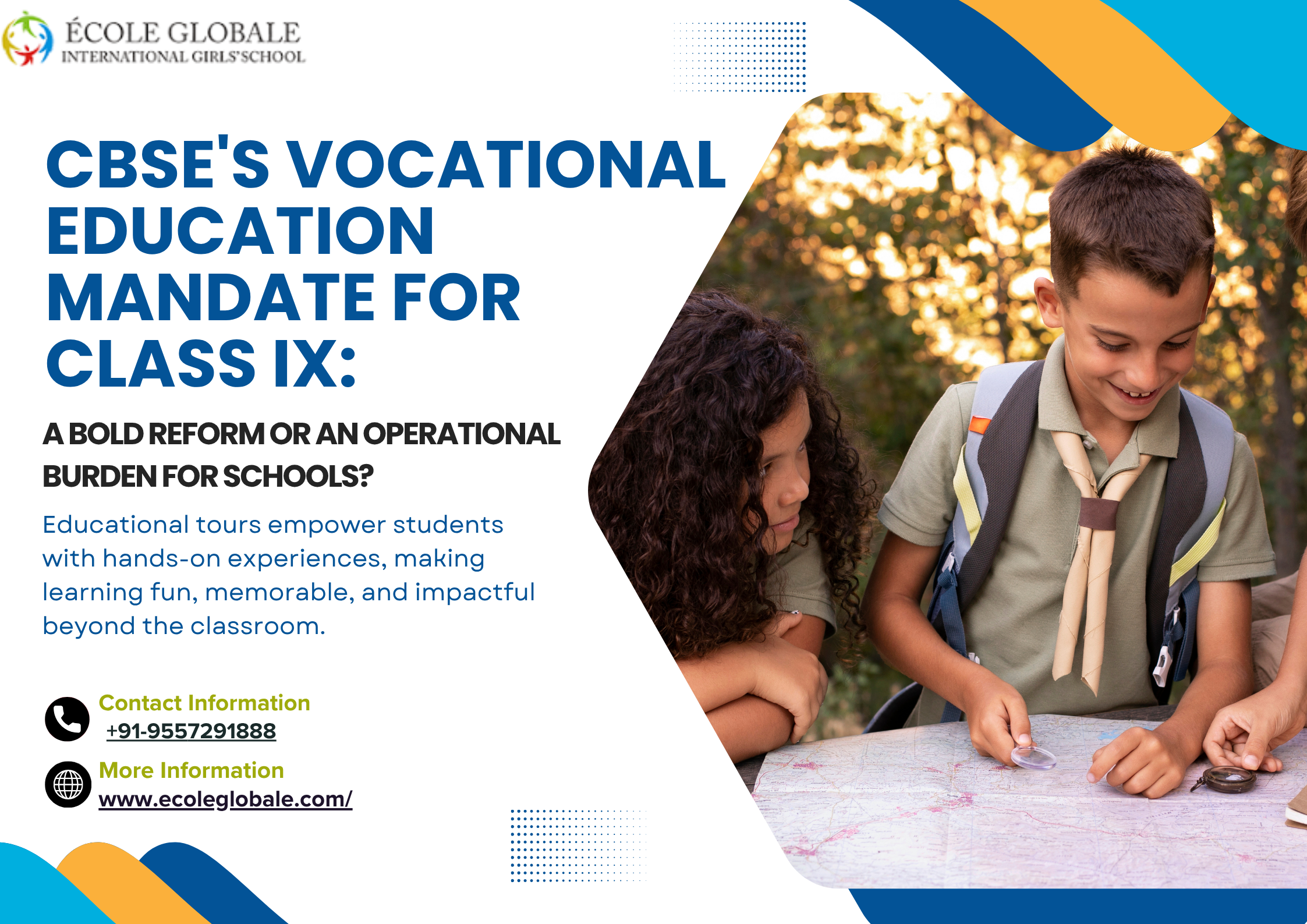
India’s school education system is experiencing a radical change for the first time in many years. The Central Board of Secondary Education (CBSE) has proposed to implement vocational education as a mandatory subject from Class IX based on the NEP 2020, which aims to reconcile the worlds of book smarts and job preparedness. The policy CBSE’s Vocational Education Mandate is certainly being applauded on one front for its progressive agenda, but the on-ground reality for many thousands of schools affiliated to CBSE is a completely different tale.
What the New Mandate Actually Says

As per the new arrangement, all the CBSE schools have been instructed to make the provision of a vocational and skill-based subject in addition to the four main subjects from the sixth to the tenth class. The “Kaushal Bodh” NCERT’s own textbook is designed on projects from our lives, based on the subjects. Children in classes six to eight will learn skills of the carpenter and gardening, mechanical repair of small vehicles, and community work in this subject.
The vocational courses in class nine and tenth grade contain structure to the skill subjects of information technology, agriculture, healthcare, data sciences, data intelligence, financial market-trading, data processing, data inputting in the fields, and the Design Thinking process.
CBSE’s Vocational Education Mandate Policy Logic: Why Now, and Why Mandatory?
For years there has been a structural disconnect between the output of our formal education system and the demands of the employment market. The output – the graduate – walks out of college and school armed with bookish knowledge but ill-equipped for the challenges thrown by industries and corporations. The NEP 2020 pointed out this was the biggest issue in Indian education and stressed the need to infuse vocational and skill education within the mainstream curriculum, rather than just treat it as a parallel, selectable offering.
The CBSE’s diktat, thus, is a straightforward step in implementing this NEP mandate.
The Board feels that by making skill subjects compulsory, all students (irrespective of the region of their school, category of the school or their social economic class) are at least exposed to some or the other applied skills before they move out of the secondary school level.
It would surely come as a big help to millions of Class X passouts who drop out without going to Class XI. Looking at the sheer scale involved, in the 2024-25 academic year over 17 lakh students at Class X from close to 24,000 CBSE schools were studying skill-related subjects. The figure at Class XII was over 2.5 lakh.
The Board wants to magnify it by mandating it at Class IX.
Where Schools Are Struggling: The Implementation Gap
- Even so, school heads – in fact all urban private schools in Delhi, Bengaluru, Pune, Dehradun and the likes – have identified real and concrete challenges in policy readying.
- Those fall into three big groups: Schools lack the physical laboratories, apparatus and the wherewithal to impart a vocational skillset in hands on way.
- If I were to provide a certification in Healthcare, or in Electronics & Hardware for instance, I’ll require lab infrastructure; something in the likes of several lakhs; Schools are short of teaching faculty who have the requisite skills in that vocational subject; the supply pipeline of the certified voc teacher doesn’t really keep pace with what you want;
- The schools in India where the load of preparing for engineering and medical entrance exam is high, they perceive this fifth elective subjects addition as an extra load on the students; their parents are often worried that marks for competitive examinations may fall and the performance the student might be impacted negatively.
CBSE’s Support Framework: What the Board Has Put in Place

Under the presumption that a mandate without support is doomed, CBSE has tried to create a framework of support and elasticity- for instance, through circular 81/2025 and predecessor circulars )Acad-29/2024 and Acad-12/2025), the board has asked schools to appoint in-charge teachers for skill education and attend the relevant implementation webinars, get a school level assessment framework in place, etc.
The statement of resource constraint has been taken into account upfront also. Schools without access to specialist facilities are allowed to design projects around resources which exist locally. A rural school would frame its Kaushal Bodh projects around mundane agricultural tasks, whereas an urban school is more likely to choose service or technology related processes. This local contextualisation is aimed at keeping the cost of entry lower without compromising on quality of skill exposure.
In the evaluation process, CBESE veers away from a written examination system, with a series of assessments running the as follows – written (10%), oral – (30%), activity books-(30%), portfolios-(10%), teacher observations – (20%). This shift aims to prevent the system from being memorised and aims to gauge more of handling skills and application rather than the knowledge of theoretical concepts on paper. For a few specific case into technical field, the CBSE have suggested that the evaluation could be left to external agencies.
The Boarding School Perspective: Unique Challenges and Advantages

For residential institutions,especially in hilly areas like Uttarakhand where most top boarding institutions are located, the vocational education imitative presents some unique challenges as well as an opportunity. Boarding schools, especially in the hills, would find it more difficult to attract vocational specialist teachers. They would also benefit from the longer hours of interaction with teachers compared to a day school, that would enable them to run skill projects within a weekly timetable.
Boarding schools are also more suited to utilize the Kaushal Bodh project framework on hands-on service, ecological care and real-life skill processes — domains where the residential school campus is a natural laboratory. A school with kitchen gardens, campus maintenance activities or community service programs already has the raw material for purposeful project-based skills learning.
What Needs to Change: Recommendations for Smoother Rollout
- School administrators and education observers have suggested a number of steps to minimize the potential turbulence of a new system:
- Phased implementation, with lead time: Rather than achieving immediate full compliance, implementation should go in structured phases, where the infrastructure and pipeline of teachers are allowed time to catch up.
- Cluster-based resource sharing: schools nearby could club vocational labs, equipment and trained teachers together and form a hub-and-spoke model (which is what CBSE has recently begun testing through its School Cluster Programme).
- Facilitation of industry partnerships: CBSE and state government should take the lead in linking school with industry partners, NGOs and vocational training centre who can provide guidance and equipment on a shared cost basis.
- Parent communication campaigns: Schools will need resources and tools to help them convince sceptical parents of the importance of vocational education. Positioning skills education as an enrichment to-rather than a substitute for-academic achievement will be essential for social acceptance of the reform.
The Bigger Picture: A Necessary Disruption
What much of education now seems to be struggling with over CBSE’s integration of vocational education is precisely the purpose. Education reform is never comfortable – and it’s been extraordinarily costly to young people’s economic prospects that India has been slow to recognize skill development as no less deserving of prioritization than rote memorization.
Instead, what the present situation calls for is not a rollback of ambition, but a real effort in implementation. The CBSE mandate points a direction. If Indian schools are able to follow itand if the board and the gvernment provide the sustained effort needed to make this workit will show if this reform is truly a significanth turning point or another well-meaning formulagetermn unconvincing in its implementation.
The challenge is higher for students. For a generation arriving in one of the fastest evolving labor markets in the world, the capacity to learn by actually doing can be just as important as any record of results.