





Choosing the right boarding school is an important decision for parents. A suitable school can support a child’s academic progress, personal development and overall wellbeing. Many parents begin their search by checking school rankings, ratings and popularity. However, choosing a school based only on rankings may overlook important factors such as teaching quality, hostel facilities, student safety and individual learning needs.
Understanding how to shortlist boarding schools requires more than comparing ranking lists. Parents should evaluate whether a school matches their child’s academic interests, personality, future goals and residential requirements.
If you are wondering how to shortlist boarding schools without relying only on rankings, this guide explains eight important factors to consider when choosing a boarding school.
Why Should Parents Know How to Shortlist Boarding Schools Beyond Rankings?
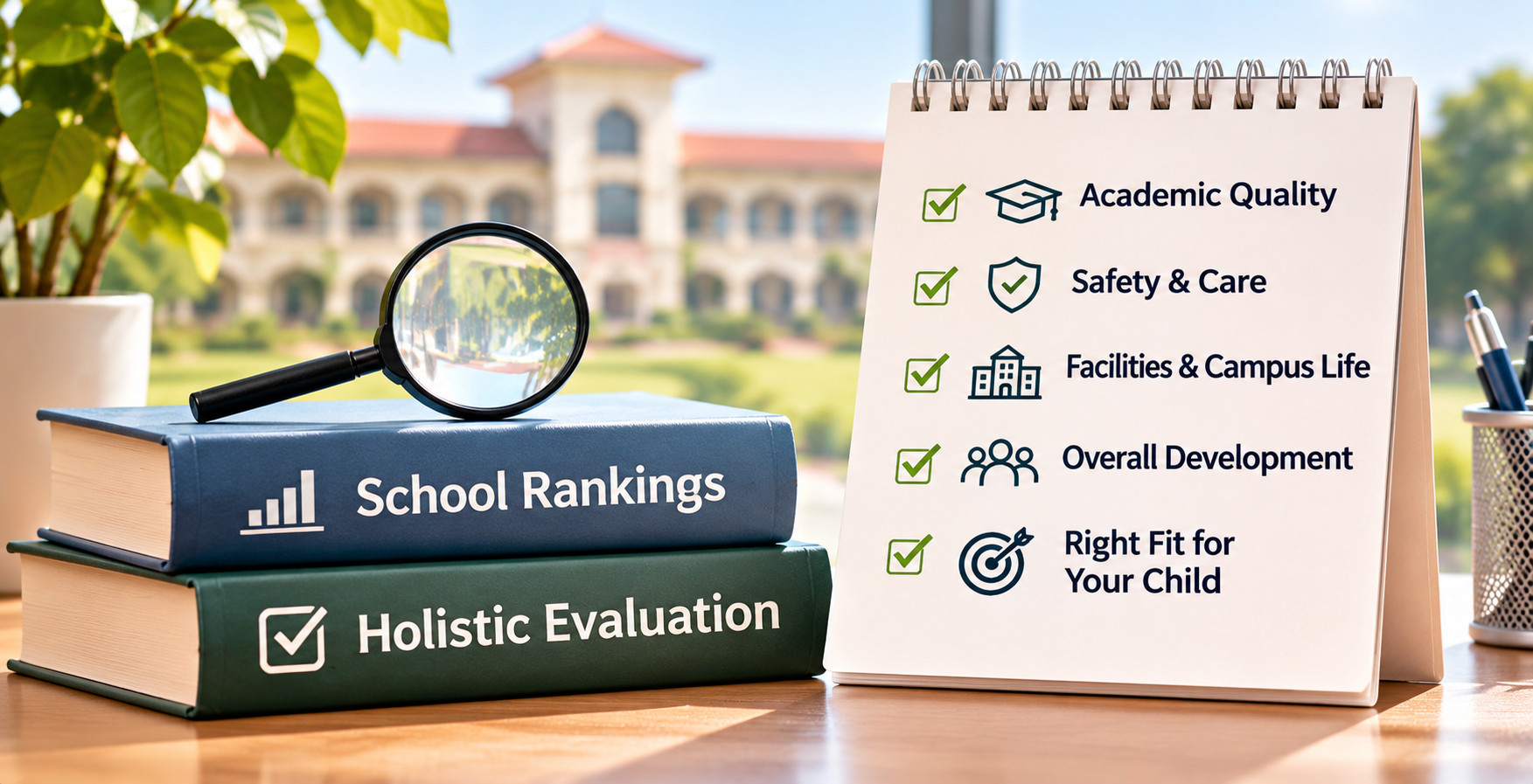
Boarding school rankings can provide an initial reference when exploring different institutions. They may help parents discover schools and compare aspects of their reputation.
However, rankings do not always reflect the complete student experience. Different ranking organisations may use different evaluation criteria, weightings and data sources.
A highly ranked school may not necessarily be the right choice for every student. One child may need additional academic support, while another may prioritise sports, creative activities or a particular curriculum.
This is why learning how to shortlist boarding schools is important. Parents should use rankings as one research tool while evaluating the actual educational and residential experience offered by each institution.
1. Understand Your Child’s Academic Needs and Interests
The first step in learning how to shortlist boarding schools is understanding your child’s academic requirements, interests and learning preferences.
Every student has different strengths and areas where additional support may be helpful. Some students prefer structured classroom teaching, while others enjoy practical activities, discussions and independent projects.
Before selecting schools, consider:
- Subjects in which your child shows interest
- Areas where additional academic support may be needed
- Preferred learning methods
- Future academic and career interests
- Interest in sports, arts and other activities
A school that matches a student’s learning preferences can provide a more suitable educational experience.
When deciding how to shortlist boarding schools, remember that the best choice should reflect your child’s individual requirements rather than simply the school’s popularity.
2. Evaluate Academic Quality and Teaching Methods
Academic quality is one of the most important factors to consider when choosing a boarding school. Instead of relying only on examination results or rankings, parents should understand how teaching and learning take place.
Review the school’s academic structure, teaching methods, teacher qualifications and student support arrangements.
Important aspects to evaluate include:
- Curriculum and subject options
- Classroom teaching methods
- Teacher-student interaction
- Academic counselling and mentoring
- Additional learning support
- Examination preparation and assessment methods
Parents should also ask how the school identifies students who need academic assistance.
When researching how to shortlist boarding schools, focus on whether the academic environment supports consistent learning, subject understanding and individual progress.
3. Check Hostel Facilities and Campus Infrastructure
Residential facilities play an important role in a student’s everyday boarding school experience.
Parents should examine the quality of hostel accommodation, dining arrangements, sanitation, study areas and recreational spaces.
Important boarding school facilities and infrastructure to evaluate include:
- Student accommodation and room arrangements
- Clean drinking water and sanitation
- Dining facilities and meal arrangements
- Study rooms and libraries
- Sports grounds and recreational spaces
- Common areas and student facilities
- Campus maintenance and hygiene
If possible, visit the school campus to understand its actual condition. Photographs and website descriptions may not provide a complete picture of everyday residential life.
Understanding how to shortlist boarding schools also means evaluating whether the residential environment is comfortable, organised and appropriate for your child.
4. Assess Student Safety and Wellbeing
Student safety and wellbeing should be among the highest priorities when selecting a residential school.
Since students spend considerable time on campus, parents should understand the school’s supervision arrangements, safeguarding policies and systems for addressing student concerns.
Questions worth asking include:
- What residential supervision arrangements are in place?
- How does the school handle student complaints?
- What medical assistance is available?
- How are emergencies managed?
- How does the school communicate with parents?
- What support is available for students experiencing emotional or academic difficulties?
Parents should also understand the school’s policies regarding bullying, student discipline and safeguarding.
Among all the factors to consider when choosing a boarding school, student safety and wellbeing deserve particular attention. A school’s ranking should never replace a careful evaluation of its safeguarding and support systems.
5. Compare Curriculum and Subject Options
Different boarding schools may follow different educational boards and curricula. Parents should understand these options before making a decision.
Some commonly available curricula include:
- CBSE: Offers a structured academic framework aligned with India’s education system.
- CISCE: Provides a broad curriculum with a range of academic subjects.
- Cambridge: Offers an internationally oriented approach with subject choices and an emphasis on conceptual understanding.
- IB: Focuses on inquiry-based learning, critical thinking and interdisciplinary education.
The right curriculum depends on the student’s learning preferences and future higher education plans.
Parents should also check whether the school offers the subjects their child may want to study in higher classes.
If you want to understand how to shortlist boarding schools effectively, compare the curriculum, teaching approach and subject availability rather than assuming one educational board is automatically better than another.
6. Explore Sports and Extracurricular Activities
A student’s development involves more than academic performance. Sports, arts, music, cultural activities and student clubs can provide opportunities to develop practical skills and explore personal interests.
Parents should examine the extracurricular programmes available at each school.
These may include:
- Outdoor games and team sports
- Music and performing arts
- Dance and cultural programmes
- Debate and public speaking
- Art and creative activities
- Leadership programmes
- Student clubs and competitions
It is also important to understand how frequently students participate in these activities and whether appropriate facilities and guidance are available.
When considering how to shortlist boarding schools, check whether the school provides opportunities that match your child’s interests beyond the classroom.
7. Understand Boarding School Fees and Additional Expenses
School fees are another important factor when learning how to shortlist boarding schools.
Parents should compare the complete cost of education rather than looking only at the advertised annual tuition fee.
Total expenses may include:
- Admission and registration charges
- Tuition fees
- Hostel and accommodation charges
- Meals and dining expenses
- Uniforms and books
- Transportation
- Sports and extracurricular charges
- Educational trips and additional activities
Ask the school for a detailed fee structure and payment schedule. Clarify whether additional expenses may arise during the academic year.
Comparing the total boarding school fees across shortlisted institutions can help families select a school that fits their financial plans.
8. Visit the Campus and Interact with School Representatives
A campus visit can help parents understand aspects of school life that may not be clear from online information.
Whenever possible, arrange a visit before making a final decision. Observe the learning environment, residential facilities and general campus arrangements.
During the visit, parents can:
- Speak with admission representatives
- Ask about academic programmes
- Understand hostel supervision
- Review available facilities
- Clarify safety and wellbeing policies
- Discuss parent-school communication
- Ask about daily student routines
Direct interaction can provide useful information and help families assess whether the institution meets their expectations.
A campus visit is an important part of how to shortlist boarding schools because it allows parents to compare actual facilities and arrangements with the information presented online.
How to Create a Boarding School Shortlist
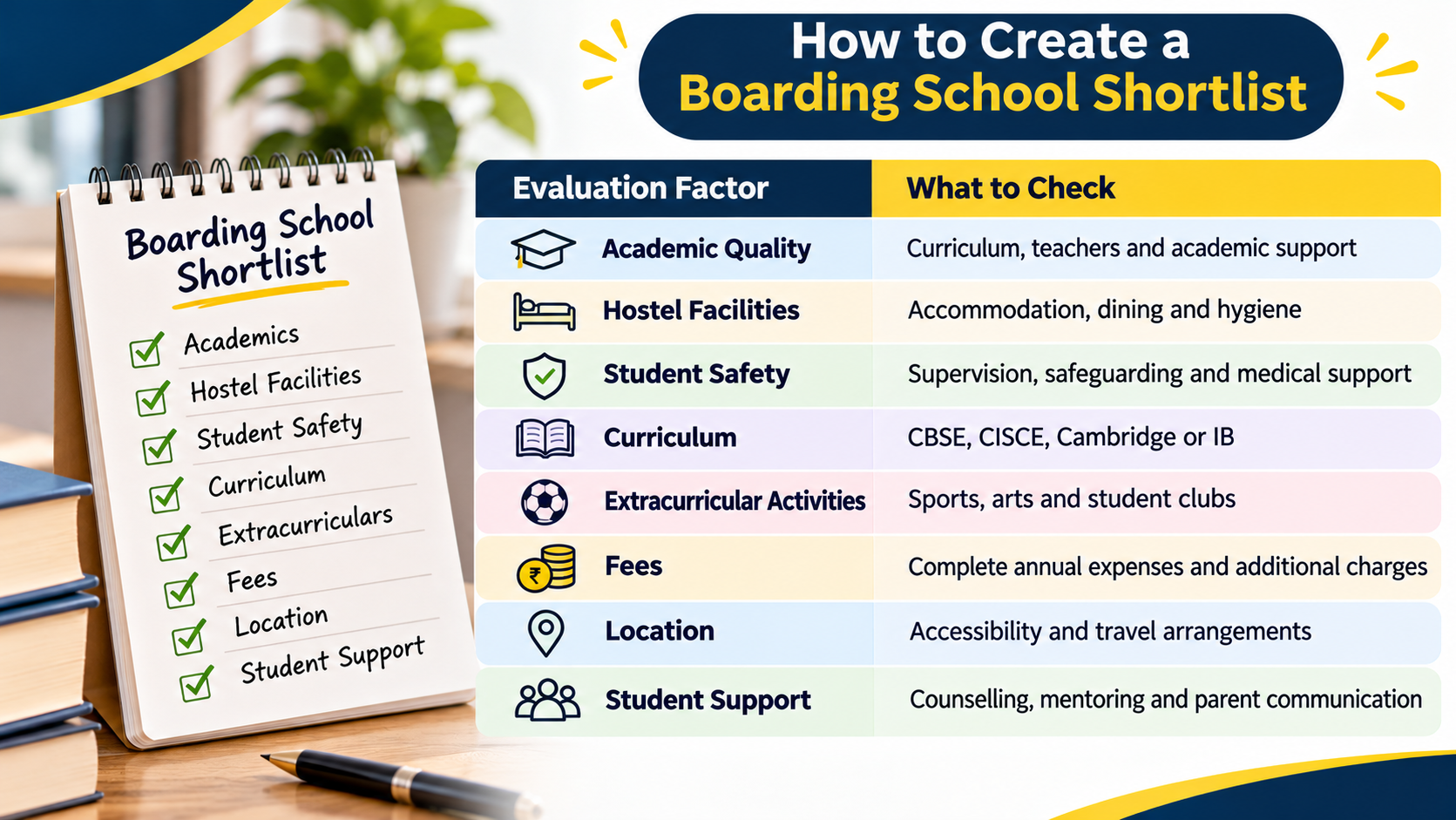
After evaluating the important factors, parents can organise their findings into a practical shortlist. This makes it easier to compare institutions objectively rather than relying only on rankings.
Consider using the following comparison table:
| Evaluation Factor | What to Check |
|---|---|
| Academic quality | Curriculum, teachers and academic support |
| Hostel facilities | Accommodation, dining and hygiene |
| Student safety | Supervision, safeguarding and medical support |
| Curriculum | CBSE, CISCE, Cambridge or IB |
| Extracurricular activities | Sports, arts and student clubs |
| Fees | Complete annual expenses and additional charges |
| Location | Accessibility and travel arrangements |
| Student support | Counselling, mentoring and parent communication |
Parents can assign importance to each factor according to their child’s needs. For example, academic support may be a priority for one student, while another may need a school with strong opportunities in sports or performing arts.
This structured approach makes how to shortlist boarding schools more organised and personalised.
Common Mistakes to Avoid When Shortlisting Boarding Schools
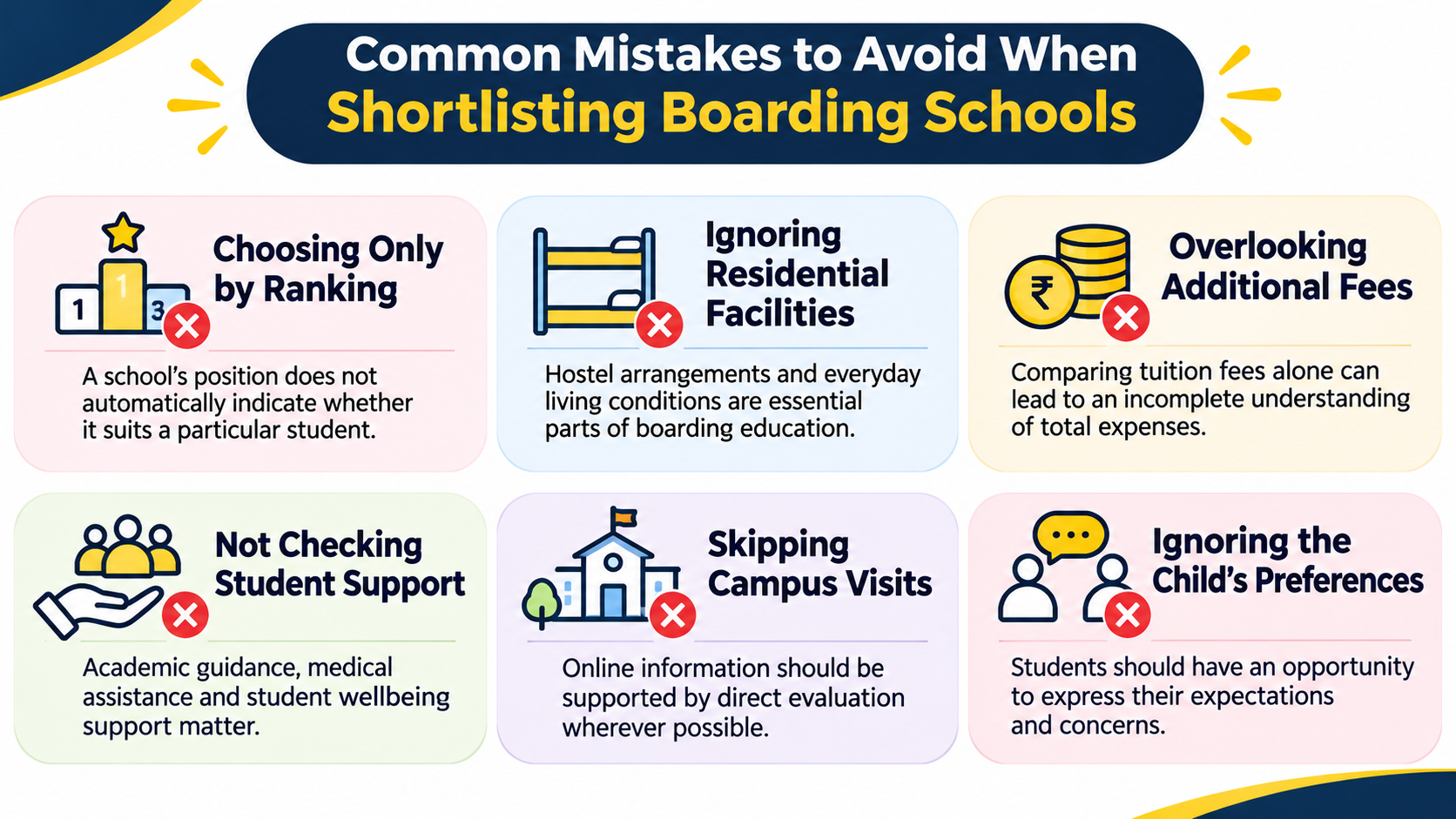
Even after researching several institutions, parents can make decisions based on incomplete information. Avoid these common mistakes when learning how to shortlist boarding schools:
- Choosing only by ranking: A school’s position does not automatically indicate whether it suits a particular student.
- Ignoring residential facilities: Hostel arrangements and everyday living conditions are essential parts of boarding education.
- Overlooking additional fees: Comparing tuition fees alone can lead to an incomplete understanding of total expenses.
- Not checking student support: Academic guidance, medical assistance and student wellbeing support matter.
- Skipping campus visits: Online information should be supported by direct evaluation wherever possible.
- Ignoring the child’s preferences: Students should have an opportunity to express their expectations and concerns.
Avoiding these mistakes can make the school selection process more informed and practical.
Conclusion
Understanding how to shortlist boarding schools involves much more than comparing rankings or selecting a popular institution. Parents should evaluate academic quality, residential facilities, student wellbeing, curriculum, extracurricular opportunities and overall expenses.
The most suitable school is not necessarily the one at the top of a ranking list. It is the institution that aligns with the student’s individual needs and provides an environment where academic learning and personal development can progress together.
By understanding the important factors to consider when choosing a boarding school, visiting campuses and comparing verified information, parents can make a more confident and informed decision about their child’s education.
Frequently Asked Questions
Q1. How to shortlist boarding schools for your child?
Ans: Start by identifying your child’s academic needs and interests. Then compare schools based on teaching quality, curriculum, hostel facilities, student safety, extracurricular activities, fees and residential support.
Q2. Are boarding school rankings reliable?
Ans: Rankings can provide a useful starting point, but their reliability depends on the organisation’s methodology and evaluation criteria. Parents should verify information independently before making a decision.
Q3. What are the most important factors to consider when choosing a boarding school?
Ans: Important factors include academic quality, curriculum, hostel facilities, student safety, teaching methods, extracurricular opportunities, fees and student support systems.
Q4. Should parents visit a boarding school before admission?
Ans: Yes. A campus visit can help parents evaluate the facilities, residential arrangements, learning environment and overall school atmosphere more directly.
Q5. How many boarding schools should parents shortlist?
Ans: There is no fixed number. Parents can begin with several suitable options and narrow them down to a manageable final list based on their requirements, budget and campus evaluations.