





In today’s fast-paced academic environment, students face increasing challenges when it comes to managing their studies effectively.
With distractions everywhere and an overload of information, knowing the right studying techniques can make a significant difference in learning outcomes.
The good news? By adopting a few proven strategies, students can not only retain information better but also reduce study-related stress and improve overall performance.
Why Studying Techniques Matter

Studying is more than just reading textbooks or taking notes. It is a skill that, when done strategically, can maximize both time and effort. The right studying techniques help students to:
Understand concepts instead of just memorizing them.
Retain information for longer periods.
Stay focused and avoid burnout.
Prepare more efficiently for exams.
These benefits make it essential for every student to develop a personalized study approach that works for them.
1. Active Recall – Learn by Testing Yourself

One of the most effective studying techniques is active recall, which involves retrieving information from memory instead of simply re-reading notes. This method strengthens neural connections and helps you remember better.
How to practice active recall:
After reading a chapter, close your book and write down everything you remember.
Use flashcards with questions on one side and answers on the other.
Teach the concept to someone else in your own words.
Research shows that students who regularly test themselves retain information longer than those who only review passively.
2. Spaced Repetition – Beat Forgetting Over Time

The brain tends to forget information quickly unless it is reviewed periodically. Spaced repetition is a studying technique that involves revisiting material at increasing intervals to reinforce memory.
Tips for using spaced repetition:
Create a review schedule (e.g., 1 day later, 3 days later, 1 week later).
Use apps like Anki or Quizlet that automate spaced repetition.
Keep your reviews short and focused on key points.
This method ensures you learn efficiently without overloading your brain.
3. The Pomodoro Technique – Study in Short Bursts

For many students, long study sessions lead to fatigue and reduced productivity. The Pomodoro Technique is a time-management studying technique that breaks study time into short, focused intervals (usually 25 minutes), followed by a 5-minute break.
How it works:
Choose a topic or task.
Set a timer for 25 minutes and study without distractions.
Take a 5-minute break.
After four sessions, take a longer break (15–30 minutes).
This method keeps your brain fresh and helps you stay consistent.
4. Mind Mapping – Visualize Information

If you are a visual learner, mind mapping is an excellent studying technique that helps organize ideas and connect concepts. This involves drawing diagrams that branch out from a central idea, making it easier to understand relationships between topics.
Steps to create a mind map:
Start with a main topic in the center of the page.
Draw branches for subtopics.
Add keywords, images, or symbols to make it more engaging.
Mind mapping is especially helpful for subjects that require understanding of complex relationships, such as history or science.
5. SQ3R Method – A Structured Reading Strategy
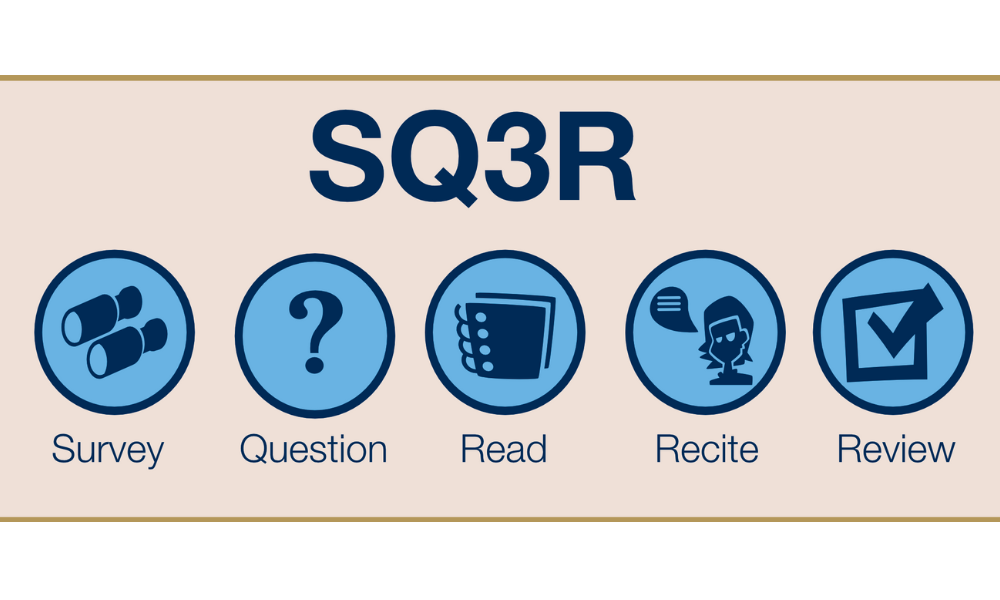
SQ3R stands for Survey, Question, Read, Recite, Review. This studying technique is designed to improve reading comprehension and retention.
How to apply SQ3R:
Survey – Skim the chapter headings, subheadings, and summary.
Question – Turn headings into questions you want answered.
Read – Read actively to find those answers.
Recite – Summarize what you learned in your own words.
Review – Revisit the material periodically.
This method helps you study with purpose and remember more.
6. Interleaving – Mix Subjects and Topics

Instead of studying one subject for hours, try interleaving, which involves switching between different topics or problem types in a single study session. This studying technique improves problem-solving skills and prevents mental fatigue.
Example: If you’re preparing for math, science, and history, rotate between them every hour. This forces your brain to adapt and apply knowledge in different contexts.
7. Healthy Study Habits – Beyond the Desk

While studying techniques focus on how to learn, your overall lifestyle also affects performance. Healthy habits can enhance your brain’s ability to absorb and retain information.
Important habits to follow:
Get enough sleep (7–9 hours).
Stay hydrated and eat brain-boosting foods.
Exercise regularly to improve concentration.
Minimize distractions by keeping your phone away while studying.
8. Group Study – Learn from Peers

Studying with peers can be motivating and provide different perspectives. In a group setting, students can test each other, explain concepts, and share resources. However, make sure the group stays focused on the task rather than turning into a social gathering.
9. Digital Tools – Modernize Your Learning

Today’s students have access to numerous apps and platforms that can make studying more interactive. From note-taking apps to AI-powered tutoring platforms, integrating digital tools into your studying techniques can make learning more effective and enjoyable.
Final Thoughts
Effective studying techniques are not one-size-fits-all. What works for one student may not work for another, so it’s important to experiment and find the right combination of strategies. Whether you prefer visual aids, interactive tools, or structured reading, the goal is to study smarter, not longer.
By adopting methods such as active recall, spaced repetition, and the Pomodoro Technique, you can make the most of your study time while keeping stress at bay. Over time, these strategies can lead to improved grades, deeper understanding, and greater confidence in your abilities.




In this blog, Ecole Globale shares smart study habits structured schedules, focused sessions, active recall, spaced repetition, visual aids, tech tools, and self-care boost learners’ efficiency and retention.