





Language learning is an important part of school education in India. The CBSE Three Language Policy is connected with the broader multilingual education approach outlined in the National Education Policy (NEP) 2020. The policy aims to encourage multilingualism while giving states, regions, and students flexibility in language choices.
For parents and students, understanding the CBSE three-language formula is useful because language requirements and available choices can vary according to the class, school, and applicable CBSE scheme of studies.
What Is the CBSE Three Language Policy?

The CBSE Three Language Policy refers to the implementation of multilingual language education within the framework of CBSE and NEP 2020.
NEP 2020 states that the three-language formula will continue while providing greater flexibility. It specifically says that no language should be imposed on any state and that the languages can be chosen by states, regions, and students, provided that at least two of the three languages are native to India.
This means that the CBSE three-language formula should not simply be understood as a fixed requirement that every student must study Hindi, English, and one particular regional language.
Instead, the policy is intended to support India’s linguistic diversity and multilingual education.
Why Was the Three Language Formula Introduced?
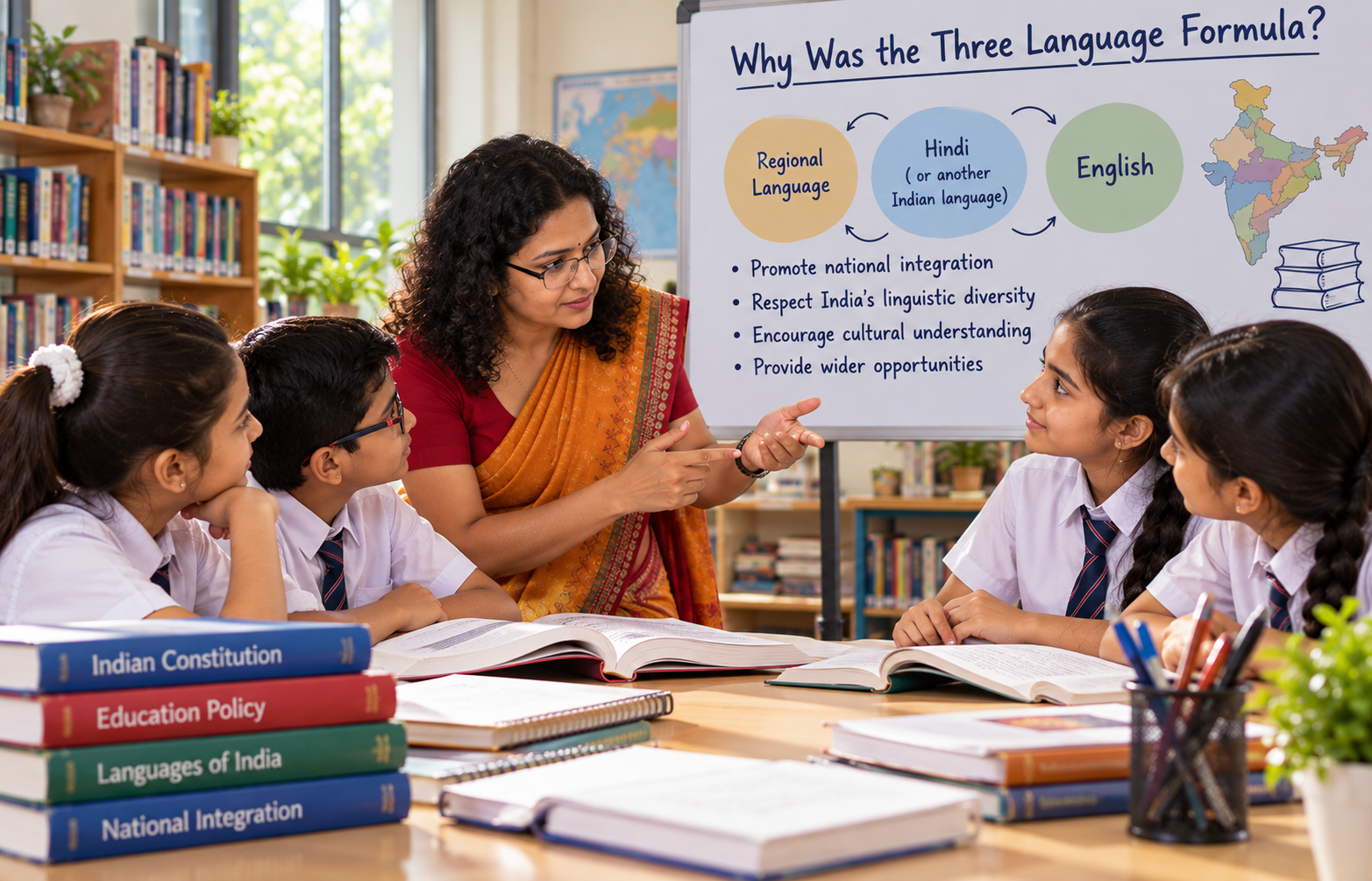
The CBSE language policy for students is linked to the broader educational goals of multilingualism, communication, cultural understanding, and national integration.
NEP 2020 describes multilingualism as an important part of India’s cultural heritage and supports greater exposure to Indian languages and their literature.
The Ministry of Education has also described multilingual education as an important part of NEP implementation, with CBSE offering numerous Indian and regional languages.
Learning more than one language can also give students opportunities to communicate with people from different linguistic backgrounds and develop familiarity with different cultures.
How Does the CBSE Three Language Formula Work?
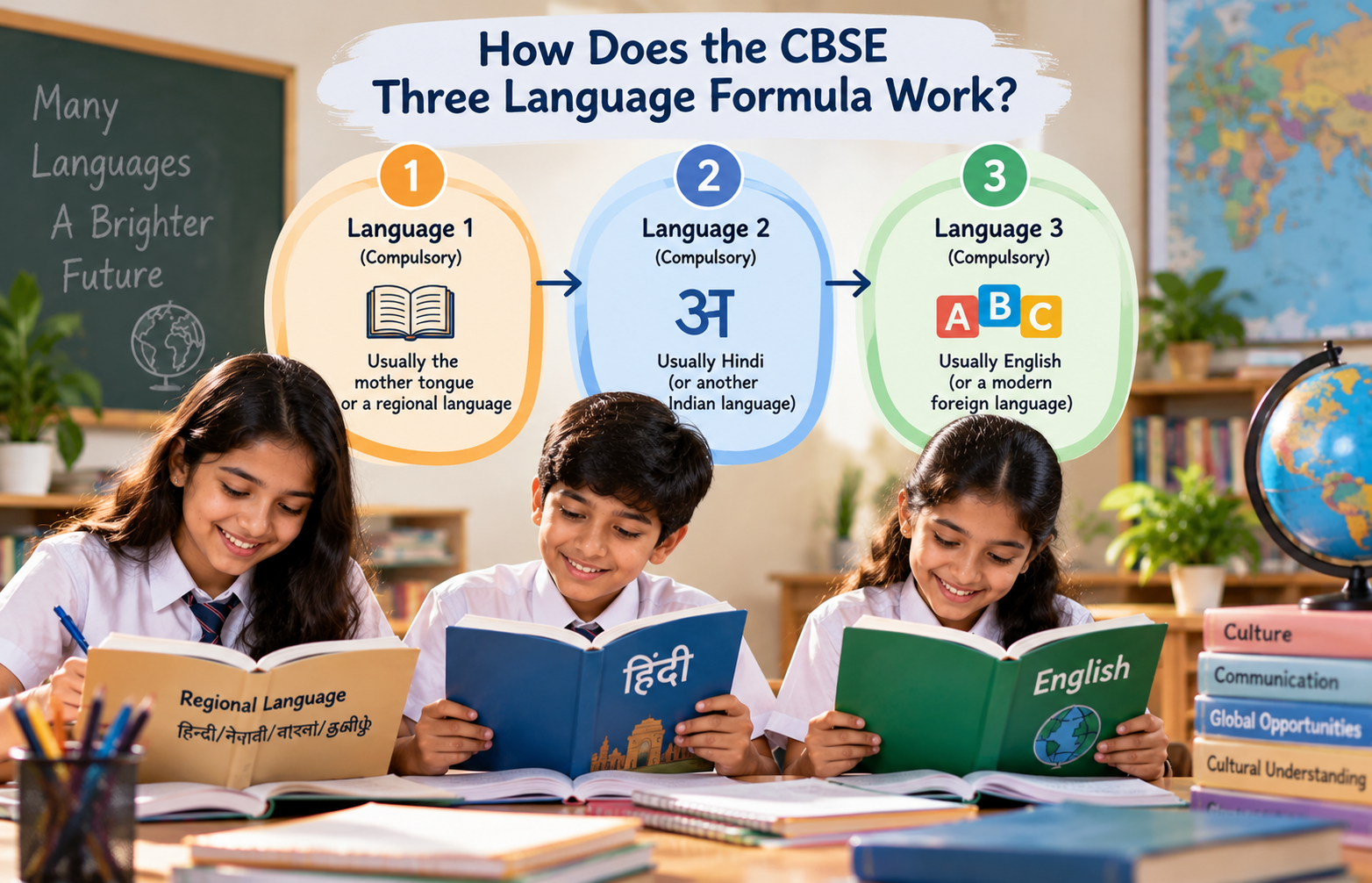
The CBSE three-language formula needs to be understood alongside the current CBSE scheme of studies and implementation guidelines.
The exact language subjects available to students can depend on the class and the languages offered by their school.
NEP 2020 provides the broader framework. It states that students can choose their three languages within the flexibility provided by states, regions, and students, with at least two of the three being languages native to India.
Importantly, CBSE’s current implementation is evolving. In December 2025, CBSE’s Governing Body approved alignment of the Three-Language Formula (R1, R2, R3) for Classes IX–X with NCF 2023, while noting that schools should continue their existing scheme of studies regarding languages until the required graded NCERT language textbooks become available.
Therefore, parents should check the latest CBSE circulars and their school’s current language scheme rather than relying on older explanations of the policy.
What Languages Can Students Study?
The CBSE language policy for students supports India’s linguistic diversity.
CBSE has offered a wide range of Indian and regional languages. Government information on NEP implementation states that CBSE’s curriculum offers 39 languages, including 29 Indian regional languages, in Classes IX–X.
The range of languages available at a particular school may be smaller because schools do not necessarily offer every language available under the broader CBSE framework.
Parents should therefore ask the school:
- Which languages are available?
- Which languages can students choose?
- Which languages are offered in each class?
- Are there minimum enrolment requirements?
- Can students change languages later?
Is Hindi compulsory under the CBSE three-language policy?
The CBSE Three Language Policy should not be interpreted as making Hindi compulsory for every student across India.
NEP 2020 explicitly states that there will be flexibility in the three-language formula and that no language will be imposed on any state. The policy also allows choices to be made by states, regions, and students, subject to the requirement that at least two of the three languages are native to India.
However, the actual subjects a student must study depend on the applicable CBSE scheme and the school’s implementation.
For this reason, parents should distinguish between the broad NEP framework and the specific language subjects prescribed or offered by their child’s school.
What Does the CBSE Language Policy Mean for Parents?

Understanding the CBSE language policy for students can help parents make informed decisions when selecting a school.
Parents should not assume that every CBSE school has identical language combinations. Schools may differ in the languages they offer and how those languages are scheduled within their curriculum.
Before admission or subject selection, parents can ask the school about:
- Available language combinations
- Language requirements for the relevant class
- Options for changing languages
- Assessment arrangements
- Availability of teachers and learning materials
- Language options in Classes IX–X and XI–XII
This can prevent confusion later in a student’s academic journey.
Benefits of Multilingual Education

The CBSE three-language formula is intended to support multilingual learning and India’s linguistic diversity.
Better Communication
Learning multiple languages can give students additional ways to communicate with people from different linguistic backgrounds.
Cultural Awareness
Language is closely connected with literature, traditions, history, and culture. Learning different languages can introduce students to cultural perspectives beyond their immediate environment.
Exposure to Indian Languages
The policy encourages students to engage with India’s diverse linguistic heritage. NEP 2020 specifically highlights the importance of awareness of India’s languages and their literature.
Broader Learning Experiences
Learning different languages can expose students to different forms of communication, vocabulary, literature, and expression.
Three Language Policies and Mother Tongue
The CBSE language policy for students is also connected to NEP 2020’s broader emphasis on Indian languages and children’s home languages.
NEP 2020 encourages high-quality bilingual teaching and learning materials, particularly for subjects such as science and mathematics, so that students can engage with concepts through their home language or mother tongue as well as English.
The policy therefore treats language not only as a subject but also as an important part of learning and cultural development.
Can Students Change Their Languages?
NEP 2020 provides flexibility for students who want to change one or more of the three languages they are studying. It states that students may make such changes in Grade 6 or 7, provided they can demonstrate basic proficiency in three languages, including one Indian language at the literature level, by the end of secondary school.
However, parents should check the current CBSE rules and their school’s implementation before assuming that a language change will be available in a particular class.
What Students Should Know About the Policy
Students should understand that the CBSE Three Language Policy is about multilingual education rather than simply adding extra subjects to their timetable.
Students may benefit from thinking about language selection in terms of:
- Their interests
- Their home or regional language
- Languages they may use in the future
- Availability at their school
- Academic requirements
- Their comfort with learning multiple languages
Choosing a language that a student is interested in can make the learning process more engaging.
Role of Schools in Implementing the Policy
Schools play an important role in implementing the CBSE three-language formula.
They need to provide appropriate language courses, qualified teachers, learning materials, and assessment arrangements according to the applicable CBSE framework.
Schools can also make language learning more engaging through:
- Reading activities
- Storytelling
- Language clubs
- Cultural programmes
- Literature activities
- Multilingual projects
- Language-related competitions
NEP 2020 also proposes a project on the “Languages of India” for students in Grades 6–8 to help them explore India’s linguistic diversity and cultural connections. The policy specifies that this activity should be enjoyable and not involve assessment.
What Parents Should Check With Their School
Because implementation can change, parents should confirm the latest information directly with the school.
Some useful questions include:
Which three languages are available in my child’s class?
Is a particular language compulsory at this school?
Can students choose from multiple Indian languages?
What are the assessment requirements?
Can students change their language later?
Which languages are available in Classes IX and X?
These questions can help families understand how the CBSE language policy for students is being implemented at their particular school.
CBSE Three Language Policy and the Future of Education
The CBSE Three Language Policy forms part of India’s broader move towards multilingual and flexible education under NEP 2020.
The objective is not simply to make students study more languages. It is also connected with communication, cultural awareness, Indian linguistic heritage, and flexible learning.
As implementation develops, parents and students should rely on current CBSE notifications, school information, and applicable curriculum documents rather than outdated explanations.
Conclusion
The CBSE Three Language Policy reflects the multilingual approach outlined in NEP 2020. The CBSE three-language formula provides a framework for learning multiple languages while allowing flexibility in language choices. NEP 2020 states that no language should be imposed on any state and that at least two of the three languages should be native to India.
For parents, the most important step is to understand the difference between the national policy framework and the specific language options available at their child’s school.
The CBSE language policy for students can provide opportunities to learn Indian languages, develop communication skills, explore literature, and understand India’s linguistic diversity. Since implementation is evolving, families should check the latest CBSE guidelines and their school’s current scheme before making decisions about language selection.
Read More: CBSE Introduces Updated Assessment Pattern for Academic Session 2026–27
Frequently Asked Questions
Q1. What is the CBSE Three Language Policy?
Ans: It is the multilingual education framework associated with CBSE and NEP 2020, under which students learn multiple languages with flexibility in language choices.
Q2. Is Hindi compulsory under the CBSE three-language formula?
Ans: The NEP 2020 framework does not impose one particular language on every state. The actual language requirements and options depend on the applicable CBSE framework and school implementation.
Q3. How many languages do CBSE students have to study?
Ans: The number and combination can depend on the class and applicable CBSE scheme of studies. Parents should check the current requirements of their school.
Q4. Can students choose their languages?
Ans: NEP 2020 provides flexibility for language choices, while requiring at least two of the three languages to be native to India under its three-language formula.
Q5. Why does CBSE promote multilingual education?
Ans: Multilingual education supports communication, cultural awareness, linguistic diversity, and greater exposure to India’s languages and literature.
Q6. Should parents check the latest CBSE guidelines?
Ans: Yes. The implementation of the three-language formula is evolving, so parents should check current CBSE notifications and their school’s language scheme before making decisions.