



Choosing the right academic pathway after Class 10 can influence a student’s subjects, learning experience, assessment style, and future education options. CBSE or CAIE after Class 10 is therefore an important question for students and parents who are planning the next stage of education.
Both CBSE and Cambridge International offer established academic pathways, but they differ in curriculum structure, subject choices, assessment approaches, and educational context. Rather than asking which one is universally better, students should consider which pathway aligns with their interests, learning preferences, and future academic plans.
Understanding CBSE or CAIE After Class 10
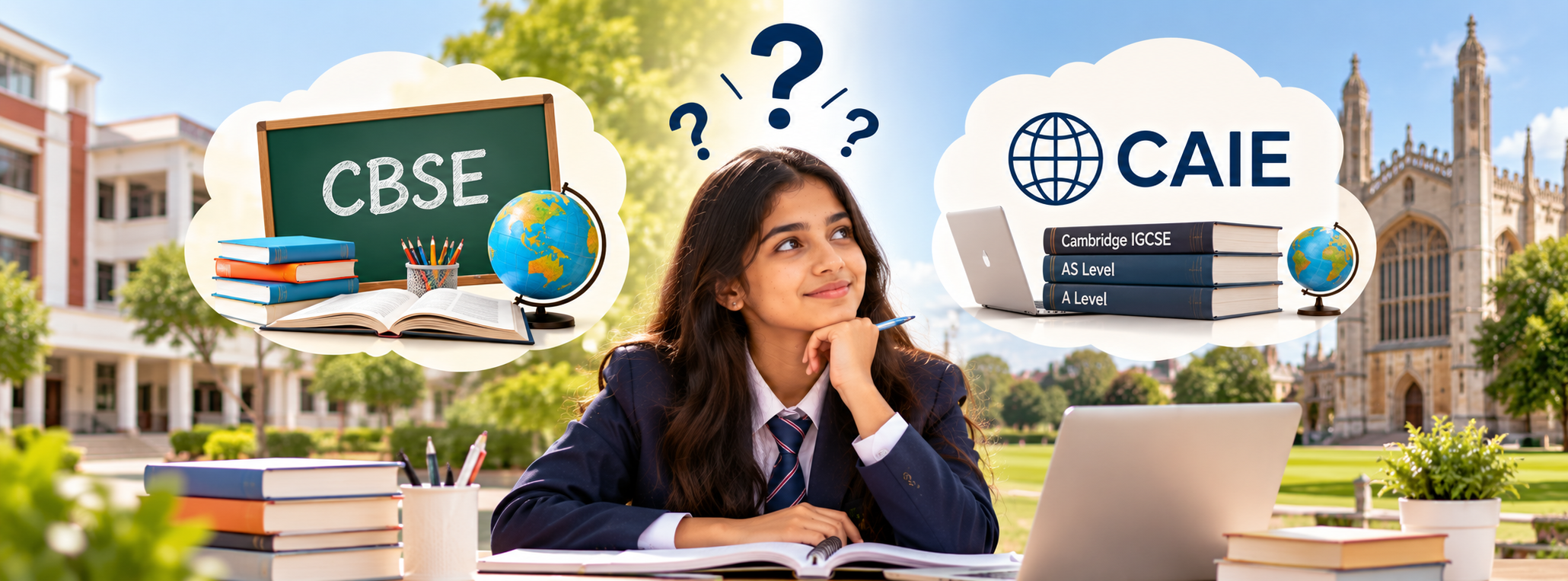
Before deciding on CBSE or CAIE after Class 10, students should understand what each pathway involves.
CBSE, or the Central Board of Secondary Education, provides senior-secondary education through Classes XI and XII. Students can select subjects according to the combinations permitted by the board and offered by their school.
CAIE, or Cambridge Assessment International Education, offers Cambridge International AS & A Level qualifications. These programmes provide students with a range of subject options and can allow greater subject specialisation.
The decision about CBSE or CAIE after Class 10 should therefore consider more than the name of the curriculum. The subjects offered by the school, teaching approach, assessment pattern, and future university requirements are also important.
CBSE After Class 10
For students considering CBSE or CAIE after Class 10, CBSE provides a familiar senior-secondary pathway within the Indian education system.
Students entering Class XI generally select subjects based on their interests and future plans. Depending on the school, options can include subjects from science, commerce, humanities, languages, mathematics, and skill-oriented areas.
CBSE can be particularly relevant for students who intend to continue their education in India and prefer a structured senior-secondary framework.
However, subject combinations can vary between schools. Students should always check the specific subjects available at the school they are considering.
CAIE After Class 10
When comparing CBSE or CAIE after Class 10, students should also understand the Cambridge pathway.
Cambridge International AS & A Level allows students to select subjects from a broad range of academic areas. Students can generally build a subject combination around their interests and future plans.
The Cambridge approach also places emphasis on understanding concepts, applying knowledge, independent thinking, analysis, and evaluation.
For students interested in an internationally orientated curriculum, CAIE can provide a different learning experience from a traditional Indian school-board pathway.
CBSE vs Cambridge Curriculum: Key Differences

Understanding the CBSE vs Cambridge curriculum can help students identify the differences that may matter to their individual goals.
Curriculum Structure
CBSE provides a structured senior-secondary framework for Classes XI and XII. Students choose from subjects and combinations available under the CBSE framework and at their school.
The Cambridge pathway provides individual AS & A Level subjects that can be combined according to the student’s academic interests and the subjects offered by the school.
Learning Approach
The CBSE vs Cambridge curriculum comparison also involves differences in learning emphasis.
CBSE provides a defined curriculum and subject framework. Cambridge International qualifications emphasise knowledge, understanding, application, analysis, evaluation, and independent thinking.
Students should consider whether their preferred learning style matches the approach followed by their chosen school.
Subject Specialisation
Subject selection is another important consideration when comparing the CBSE vs Cambridge curriculum.
Students should identify the subjects they need for their intended higher-education pathway. Cambridge AS & A Level can allow students to focus on selected subjects, while CBSE provides subject combinations within its senior-secondary framework.
The actual choices available will depend on the school.
Subject Choices After Class 10
Subject selection should be at the centre of the CBSE or CAIE after Class 10 decision.
A student interested in engineering may need mathematics and physics, while a student interested in medicine may need biology, chemistry, and other required subjects. Students interested in economics, business, humanities, psychology, design, or other fields may need different combinations.
Before choosing a curriculum, students should ask:
- Which subjects do I enjoy?
- Which subjects match my academic strengths?
- What subjects are required for my future course?
- Does the school offer those subjects?
- Would I prefer broader study or greater specialisation?
These questions can make the choice between CBSE and CAIE after Class 10 more practical.
Assessment and Examinations

Assessment is another factor to consider when examining the CBSE vs Cambridge curriculum.
CBSE students follow the assessment and examination requirements established for their senior-secondary programme.
Cambridge International AS & A Level qualifications are assessed separately by subject. Assessment methods can vary depending on the subject and qualification.
Students should therefore review the assessment structure of their intended subjects before making a decision.
Understanding how examinations, practical assessments, coursework (where applicable), and other forms of assessment work can help students choose a pathway that matches their learning preferences.
Higher Education Pathways
Future university plans are an important part of the CBSE or CAIE after Class 10 decision.
Students planning to study in India should check the latest eligibility and subject requirements of their preferred universities and courses. Competitive programmes can have specific subject prerequisites.
Cambridge International qualifications are recognised by universities in India and internationally, subject to applicable requirements. However, recognition alone does not mean that every university or course has identical admission criteria.
Students interested in studying abroad should also check the requirements of their intended universities before selecting their Class XI subjects.
Which Path May Fit Different Students?

There is no universal answer to CBSE or CAIE after Class 10.
CBSE may be considered by students who:
- Prefer a familiar Indian education pathway.
- Plan to continue primarily within the Indian education system.
- Want a structured senior-secondary curriculum.
- Find suitable subject combinations at their preferred CBSE school.
CAIE may be considered by students who:
- Prefer an internationally orientated curriculum.
- Want to explore individual subjects in greater depth.
- Value independent thinking and application of knowledge.
- Are considering universities in India or other countries and have checked their requirements.
These are general considerations, not fixed rules. A student’s school, teachers, subjects, learning environment, and academic goals should all be considered.
Factors to Consider Before Choosing
When deciding between CBSE and CAIE after Class 10, students and parents can compare the following factors.
1. Future Academic Goals
Think about possible degree programmes and career areas. Students do not need to have their entire career planned at Class 10, but having some direction can help with subject selection.
2. Subject Availability
Check the subjects actually offered by the school. Not every school offers every subject available under a particular curriculum.
3. Learning Style
Consider whether the student prefers structured learning, independent study, subject specialisation, practical application, or a particular assessment approach.
4. University Requirements
Research the current requirements of universities and courses that interest the student.
5. School Environment
Curriculum is only one part of education. Teaching quality, academic support, extracurricular opportunities, facilities, student support, and the overall school environment also matter.
CBSE or CAIE After Class 10: Making the Decision

The decision about CBSE or CAIE after Class 10 should be based on the student’s academic interests and future plans rather than simply choosing the curriculum that appears more popular.
The CBSE vs Cambridge curriculum comparison can help students understand differences in structure, subject choices, learning approaches, and assessment. However, the specific school offering the curriculum is equally important.
Students should compare the subjects they want, review university requirements, understand the assessment structure, and discuss their options with teachers or academic counsellors.
A thoughtful decision at the end of Class 10 can help students enter Classes XI and XII with clearer academic goals and a better understanding of their chosen pathway.
Frequently Asked Questions
Q1. Is CBSE or CAIE after Class 10 better for every student?
Ans: No. The appropriate pathway depends on the student’s academic interests, learning preferences, subject requirements, and future education plans.
Q2. What is the main difference between the CBSE and Cambridge curricula?
Ans: The two pathways differ in curriculum structure, subject selection, assessment, and learning approach. Cambridge International AS & A Level provides a broad range of individual subjects, while CBSE provides a structured senior-secondary framework.
Q3. Can CAIE students study at universities in India?
Ans: Yes. Cambridge International qualifications are recognised by universities in India, subject to applicable equivalence and individual university or course requirements.
Q4. How should students choose subjects after Class 10?
Ans: Students should consider their interests, academic strengths, future degree requirements, and the subjects actually offered by their school.
Q5. Should parents consider the school as well as the curriculum?
Ans: Yes. When comparing CBSE or CAIE after Class 10, parents should also consider teaching quality, subject availability, academic support, facilities, extracurricular opportunities, and the overall learning environment.
Q6. Can students change their academic direction later?
Ans: It depends on the subjects already studied and the requirements of the future course. This is why checking university and course requirements before selecting Class XI subjects can be useful.