




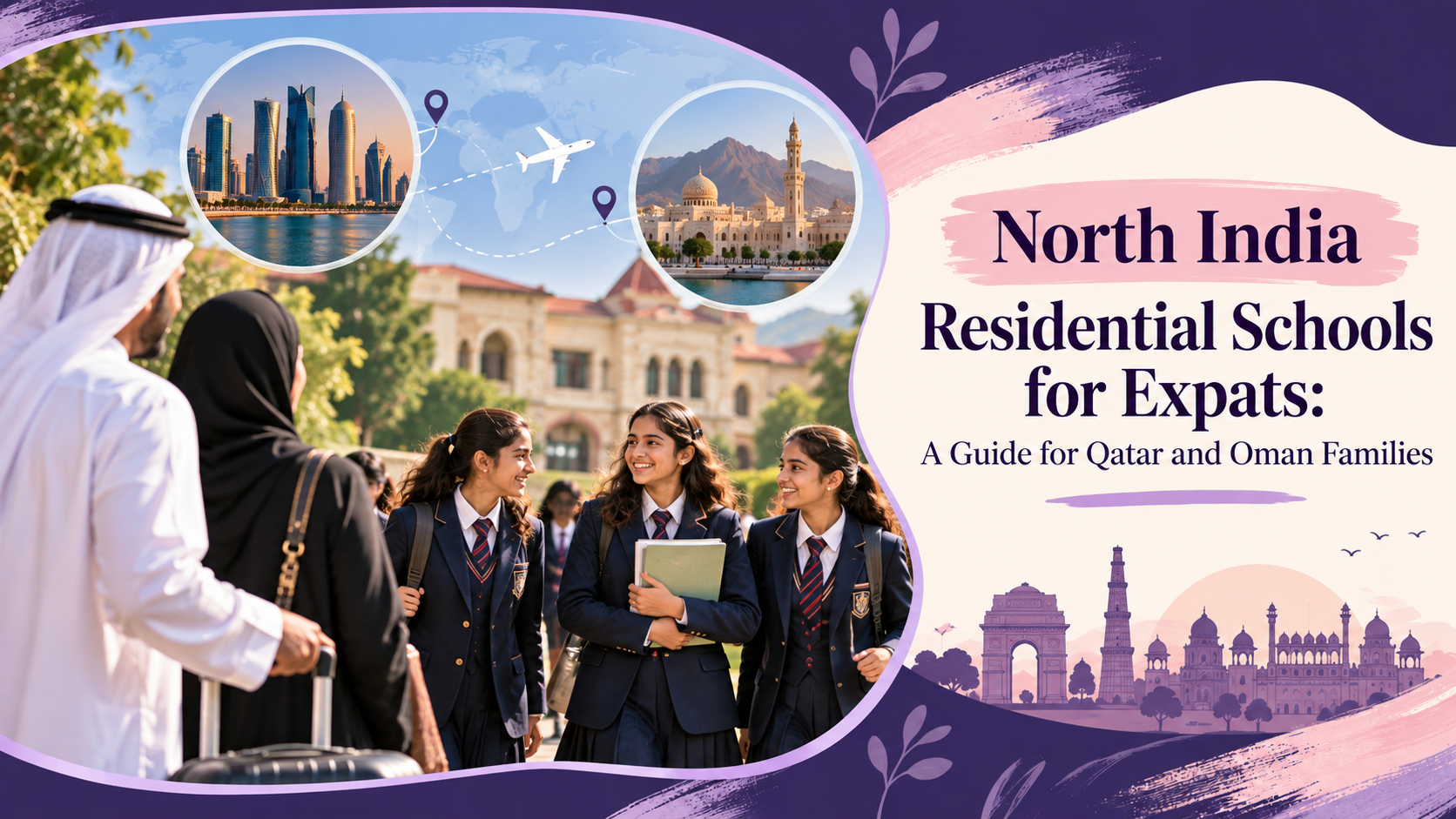
Choosing the right school can be a major decision for families living outside India. Parents in Qatar and Oman often look for an education that combines strong academics, structured residential life, extracurricular opportunities, and a supportive environment.
For these families, North India residential schools for expats can offer an alternative to day-school education while allowing students to experience a structured campus community in India.
From curriculum and boarding facilities to safety, communication, and admission requirements, consider several factors before deciding.
Why Consider North India Residential Schools for Expats?

North India residential schools for expats offer an organised educational environment with academics, sports, extracurricular activities, and residential life.
Parents may consider residential education because it can provide:
- Structured academic routines
- Supervised residential facilities
- Sports and extracurricular activities
- Opportunities to develop independence
- Interaction with students from different backgrounds
- Dedicated study periods
- Opportunities for leadership and personal development
However, every school is different. Parents should compare individual schools rather than assuming that all residential schools offer the same facilities or educational approach.
Why North India May Appeal to Gulf Expat Families
Families living in Qatar and Oman may consider India for their children’s education for several reasons, including familiarity with Indian curricula, cultural connections, family ties, and access to established residential schools.
North India residential schools for expats are located across several regions, including Uttarakhand, Himachal Pradesh, Rajasthan, Haryana, and other northern parts of the country.
The right location depends on factors such as:
- Accessibility from airports
- Distance from family
- School environment
- Climate
- Curriculum
- Boarding facilities
- Academic requirements
Choosing the Right Curriculum

Curriculum should be one of the first factors parents evaluate when considering North India residential schools for expats.
Schools may offer different educational programmes, such as CBSE, Cambridge, IB, or other recognised curricula.
Parents should consider:
Current Curriculum
What curriculum is the child currently studying in Qatar or Oman?
Future Education
Where does the family expect the child to pursue higher education?
Subject Choices
Does the school provide the subjects the student is likely to need in senior grades?
Academic Transition
Will the child be able to transition smoothly from their current school system?
Considering these questions early can help families create a practical shortlist.
Boarding Facilities and Residential Life

For expat families, residential facilities are particularly important because parents may be living in another country.
When evaluating North India residential schools for expats, parents should look at:
- Boarding houses
- Student rooms
- Residential supervision
- House parents or residential staff
- Dining facilities
- Study areas
- Recreation spaces
- Laundry arrangements
- Student communication facilities
Parents should also understand what a typical day looks like for students and how the school balances academics, activities, meals, study time, and rest.
Safety and Student Supervision
Safety should be a priority when choosing any residential school.
Parents should ask North India residential schools for expats about their current arrangements for:
- Campus security
- Boarding supervision
- Student movement
- Emergency procedures
- Medical support
- Visitor management
- Transportation
- Communication during emergencies
Rather than relying only on general claims, parents should ask schools for clear information about their policies and procedures.
Academic Support for Expat Students

Students moving from Qatar or Oman may have different academic backgrounds depending on their previous school.
Parents should therefore understand how North India residential schools for expats support students who are transitioning into a new academic environment.
Important questions include:
- How accessible are teachers?
- Is supervised study provided?
- What academic support is available?
- How are students assessed?
- How are parents informed about academic progress?
- Is additional support available when required?
A clear academic support system can make the transition easier.
Sports and Extracurricular Opportunities
Education at a residential school can extend beyond classroom learning.
Parents researching North India residential schools for expats can compare opportunities such as:
- Sports
- Music
- Performing arts
- Visual arts
- Clubs
- Debates
- Leadership activities
- Community service
- Outdoor activities
These opportunities can help students explore interests and develop skills such as teamwork, communication, creativity, organisation, and responsibility.
Supporting Independence
Residential education can give students opportunities to manage age-appropriate responsibilities within a structured environment.
Students may gradually learn to:
- Organise their belongings
- Follow daily routines
- Manage study schedules
- Participate in activities
- Work with peers
- Take responsibility for commitments
This can be particularly relevant for parents considering North India residential schools for expats, as students may spend extended periods away from their families.
Communication With Parents in Qatar and Oman

Distance makes parent-school communication an important consideration.
Before selecting North India residential schools for expats, parents should understand how they will stay informed about their child’s education and residential experience.
Ask about:
- Parent-teacher communication
- Academic progress reports
- Residential updates
- Emergency communication
- Student-parent communication
- School events
- Holiday arrangements
Parents should know whom to contact if they have an academic, residential, or wellbeing-related concern.
Boarding Schools for Gulf Expat Children

Boarding schools for Gulf expat children can provide a structured environment for students who are studying away from their parents.
However, the transition can be significant. Children may need time to adjust to:
- Residential routines
- New classmates
- Different academic expectations
- School rules
- Independent responsibilities
- Being away from family
Parents can support this transition by discussing residential life openly and involving their child in the school-selection process.
Considering Dehradun
Dehradun is one destination that families can consider when researching North India residential schools for expats.
The city is known for its residential education environment and has schools offering different curricula and boarding models.
For families from Qatar and Oman, Dehradun may also be worth considering in terms of accessibility and the range of educational options available.
However, parents should evaluate each school individually rather than choosing a location alone.
Ecole Globale for Expat Families
Ecole Globale International Girls School in Dehradun can be considered by families looking for a girls’ residential school in North India.
Families from Qatar and Oman should review the school’s current information regarding:
- Curriculum
- Boarding facilities
- Admission requirements
- Fees
- Sports and extracurricular activities
- Student support
- Communication with parents
Parents should contact the school directly for the latest admission requirements and arrangements applicable to expatriate families.
How to Compare North India Residential Schools for Expats
Creating a comparison checklist can make the selection process easier.
| Factor | What Parents Should Compare |
|---|---|
| Curriculum | CBSE, Cambridge, IB or other programmes |
| Boarding | Accommodation and supervision |
| Academics | Teaching and academic support |
| Location | Airport access and travel convenience |
| Safety | Security and emergency procedures |
| Activities | Sports, clubs and extracurriculars |
| Student Support | Academic and residential guidance |
| Communication | Parent-school communication |
| Fees | Tuition, boarding and additional costs |
| Admission | Eligibility and required documents |
This approach allows families to compare schools according to their actual requirements.
Admission Requirements for Expat Students

Admission requirements can vary between schools and may also depend on the student’s previous education.
Parents considering North India residential schools for expats should ask about:
- Application deadlines
- Academic records
- Previous school reports
- Entrance assessments
- Interviews
- Identity and travel documents
- Medical documentation
- Transfer certificates
- Visa or residency-related documentation, where applicable
Because requirements can change, families should confirm the latest documentation directly with each school.
Preparing Your Child for Residential School
Moving from Qatar or Oman to a residential school in India can be a major adjustment.
Parents can prepare their child by discussing:
- Daily boarding routines
- Academic expectations
- Study schedules
- Sports and activities
- Communication with family
- Personal responsibilities
- School rules
- Holidays and travel arrangements
It can also help to involve the child when comparing schools. Understanding their interests and concerns can make the transition more comfortable.
Questions Parents Should Ask Before Choosing a School
Before finalising one of the North India residential schools for expats, parents should ask:
- Which curriculum does the school offer?
- What are the boarding arrangements?
- How are students supervised?
- What academic support is available?
- What sports and extracurricular activities are offered?
- How does the school communicate with parents overseas?
- What medical and emergency facilities are available?
- What are the complete boarding and academic costs?
- What are the admission requirements for expatriate students?
- How are school holidays and travel arrangements managed?
Getting clear answers can help families make a more informed decision.
Conclusion
Choosing among North India residential schools for expats requires more than comparing school names or rankings. Families in Qatar and Oman should consider curriculum, boarding facilities, safety, academic support, extracurricular activities, communication, location, fees, and admission requirements.
Boarding schools for Gulf expat children can provide a structured educational environment where students experience academics, residential life, sports, activities, and opportunities for personal development.
For families considering Ecole Globale or another residential school in North India, the best approach is to compare the complete school experience and select an environment that matches the child’s academic needs, interests, personality, and future plans.
Frequently Asked Questions
Q1. What should Qatar and Oman expat families consider when choosing a residential school in North India?
Ans: Parents should compare the curriculum, boarding facilities, student safety, academic support, extracurricular activities, location, fees, and communication arrangements for families living abroad.
Q2. Are there residential schools in North India for expat children?
Ans: Yes. Families can explore residential schools across North India, including options in Uttarakhand and other northern states. Each school should be evaluated based on its curriculum, residential facilities, admission requirements, and student support.
Q3. What are the benefits of boarding schools for Gulf expat children?
Ans: Boarding schools for Gulf expat children can provide structured academic routines, supervised residential life, extracurricular opportunities, and an environment that encourages independence and responsibility.
Q4. Is Dehradun a good option for expat families looking for residential schools?
Ans: Dehradun can be included in a shortlist of North Indian residential education destinations. Parents should compare individual schools based on academics, boarding facilities, student support, activities, and accessibility.
Q5. How can parents in Qatar or Oman stay connected with their child?
Ans: Parents should check each school’s communication system, including academic updates, parent-teacher communication, student contact arrangements, emergency communication, and holiday procedures.