





STEM school India story has a paradox at its centre: women make up roughly 43% of STEM higher-education enrollment in India — ahead of most developed countries — yet only about 27% of the STEM workforce.
A genuine STEM school in India isn’t just one with science and computer labs; it’s one that teaches Maths and Science through inquiry and application rather than pure memorisation, and — increasingly, the research suggests — one that addresses the social barriers that cause girls to lose interest or confidence in STEM subjects well before university.
This is where girls-only STEM education has started gaining real ground: not as a niche preference, but as a direct response to why India’s strong STEM enrollment numbers don’t carry through to the workforce.
What Actually Makes a School a STEM School in India
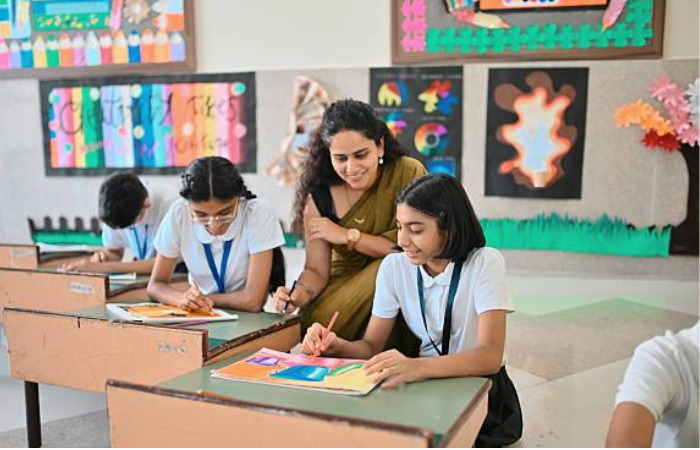
Most CBSE and ICSE schools already have science and computer labs, so lab infrastructure alone doesn’t distinguish a genuine STEM school. What does:
- Inquiry-based teaching: Science and Maths taught through problem-solving and application, not just formula memorisation and recall.
- Early coding exposure: Computational thinking and coding introduced well before senior secondary, not bolted on as a Class 11 elective.
- Assessed lab and project time: Hands-on work that counts toward evaluation, not just supplementary demonstration.
- Visible STEM participation: Active involvement in science olympiads, robotics competitions, and research projects — with leadership roles genuinely open, not defaulted to a subset of students.
India’s STEM Paradox, in Numbers
| Indicator | Figure |
| Women’s share of STEM higher-education enrolment (India, 2021-22) | ≈ 43% — ahead of most developed countries |
| Women’s share of India’s STEM workforce | ≈ 27% |
| Drop in women taking postgraduate engineering/IT (2013-14 to 2021-22) | 43% |
| Class XI+ students actually in STEM streams (Physics/Chemistry/Math/Biology) | ≈ 31.7%, vs 55.7% in Arts/Humanities (ASER 2023) |
| Women reporting gender bias in STEM performance evaluations | ≈ 81% |
| Women in India’s data-science/AI roles vs engineering roles | 26% and 15% respectively |
Figures compiled from AISHE, ASER 2023, IWWAGE, World Bank, and peer-reviewed research on India’s STEM gender gap, most recent available data as of 2025-26.
Why the Gap Starts in School, Not College
Research on STEM school India gender gap consistently points to a social rather than an ability-based explanation. STEM is still widely perceived in India as a masculine domain — a perception that filters down through parents, peers, and educators, and that steers girls away from Maths and technology-related interests well before career decisions are made. In mixed classrooms, this can show up subtly: fewer girls volunteering answers in Science and Maths, fewer girls taking on lab-lead or competition-team roles, and, over time, a quiet erosion of the confidence that early academic performance would otherwise support. Notably, girls in India often match or exceed boys academically in Maths and Science during school — the gap isn’t about capability, it’s about what happens to confidence and encouragement afterward.
Why a Girls-Only Environment Changes the STEM Equation

A single-sex environment doesn’t fix every structural barrier in India’s STEM pipeline — workplace bias and postgraduate attrition happen well after school. But it removes one specific, well-documented barrier during the years when STEM interest and confidence are still forming: every leadership role in the science club, every robotics team captaincy, every olympiad team spot goes to a girl by default, because there’s no other option. That structural fact changes participation patterns in ways mixed classrooms often don’t, particularly in subjects where social stereotype otherwise shapes who puts their hand up first.
This is part of why Ecole Globale International Girls’ School in Dehradun structures its academic approach the way it does — a dual CBSE and Cambridge International curriculum that combines CBSE’s exam-focused Science and Maths rigor with Cambridge’s inquiry-based, application-driven teaching style, delivered entirely within a girls-only environment where STEM leadership and participation aren’t competing against classroom dynamics that research shows can work against girls elsewhere.
What to Look For in a STEM-Strong School
- Ask what grade coding starts in: Early, consistent exposure matters more than a single senior-year elective.
- Ask for the lab-to-lecture ratio: Not just lab existence, but how much actual class time is hands-on.
- Ask about Class 11 stream distribution: What share of students actually choose Science/Maths streams, and how that’s trended over recent years.
- Ask who leads competitions and clubs: Leadership and participation numbers reveal more about real STEM culture than a curriculum brochure does.
Frequently Asked Questions
Q1. What actually makes a school a STEM school in India?
Ans: Beyond having science and computer labs — which most CBSE and ICSE schools have — a genuine STEM-focused school teaches Maths and Science through inquiry-based, application-driven methods rather than pure memorisation, integrates coding and computational thinking from an early grade, and gives students hands-on project and lab time that’s assessed alongside, not instead of, board exam preparation.
Q2. Is a girls-only school better for STEM education than a co-ed school?
Ans: Research on India’s STEM gender gap consistently points to social perception, not ability, as the main early barrier — STEM is widely perceived as a ‘boys’ club,’ and mixed classrooms can amplify that stereotype through unequal participation and confidence gaps. A girls-only environment removes that specific social barrier during the school years when interest and confidence in STEM subjects are still forming, though it isn’t the only factor that matters.
Q3. Why does India have strong STEM enrollment but weak STEM workforce participation?
Ans: This is often called the leaky pipeline: India’s female STEM higher-education enrollment (≈43%) already leads much of the world, but participation drops sharply by the workforce stage (≈27%), and further at senior levels. Researchers point to social norms, workplace bias, and a steep drop in women pursuing postgraduate engineering and IT (down 43% between 2013-14 and 2021-22) as key points where women exit the pipeline after school.
Q4. Does board (CBSE vs Cambridge) affect STEM learning quality?
Ans: It affects the teaching style more than the content depth. CBSE’s NCERT-based Science and Maths are strong preparation for India’s competitive exams, while Cambridge’s IGCSE and A-Level science curriculum leans more heavily on coursework, research, and applied problem-solving. A dual-curriculum school can draw on both — CBSE’s exam rigor and Cambridge’s inquiry-based approach — rather than choosing one teaching style over the other.
Q5. At what age should STEM exposure start for girls?
Ans: Most researchers and education policy documents, including India’s NEP 2020, point to early and consistent exposure — ideally from primary school — as more effective than introducing STEM emphasis only at the senior secondary level, since interest and self-confidence in these subjects tend to form well before Class 9.
Q6. What should parents specifically ask a school claiming to be ‘STEM-focused’?
Ans: Ask what grade coding/computational thinking starts in, what share of science teaching time is lab-based versus lecture-based, how many students go on to STEM streams in Class 11, and — if choosing a girls-only school — how leadership roles in science clubs, olympiads, and competitions are distributed, since genuine STEM confidence-building shows up in participation numbers, not just curriculum descriptions.